
by Chris Sheehy
-
While your Google Analytics may show very different behavior, AI actually hasn’t killed your website or SEO; it has simply raised the bar for both. Undeniably, SEO is not dead - it’s the foundation for AI visibility - so half-baked “set it and forget it” jumpstart tactics will quietly get you filtered out while competitors pick-up market share. Now is the time for either a more robust SEO budget or a patient, right-sized plan: either way, don’t abandon SEO, but do trim underperforming marketing like social media, paid ads, and random boosted posts so you can reinvest in the one channel that consistently delivers the strongest long-term lead flow and also powers your visibility across both search engines like Google & Bing, and AI
My conversations with businesses across Rhode Island and southeastern Massachusetts often reveal a deep anxiety. There is a fear that artificial intelligence will make digital marketing and online branding obsolete.
Business owners worry that their web and SEO investments to date will be wiped out. They are questioning whether they should stop investing in website development or search engine optimization. Developers are struggling to figure out what changes they need to make so their work delivers the results their clients expect. Everyone is wondering if and how they should double down on AI instead of what has traditionally worked. It feels like the rules have suddenly changed after decades of consistency.
The reality, though, is less frightening than the hype. With nearly 30 years of SEO experience in this industry, I’ve witnessed the birth of both Google and Bing and have navigated every major evolution of search technology and digital marketing since 1997. I can assure you that this is not the end of websites, SEO, or digital marketing; it is simply the next evolution.
AI isn't replacing search engines. In fact, AI is the ultimate "power user" of search engines. If you divest resources (funds and effort) away from SEO, your chances of visibility on AI will be reduced.
AI Isn't Magic. It's Research.
The biggest misconception about tools like Google Gemini, Perplexity, and ChatGPT is that they're magical boxes that produce answers out of thin air. They aren't. They are simply hyper-efficient research assistants.
To understand this, let's look at a real-world example. Imagine you're a restaurant owner, and a potential customer pulls out their phone and asks Gemini, "What are the best restaurants in Rhode Island?"
Traditionally, you would have typed or spoken this into Google, sifted through ten 🔵blue links, and visited many restaurant websites to find a place to eat. Today, the AI does that searching and sifting for you in a fraction of a second by triggering a process called a "Query Fan-Out," in which AI instantly sends dozens—sometimes multiples of dozens—of digital "search parties" to find, quantify, and sort the top 4-5 best facts across the web before providing an answer.
Visualizing the AI Query Fan-Out
This is difficult to visualize in words, I get it, but take a look at the "Hub and Spoke" diagram below, which illustrates the process of a search that we have all performed in some form. It shows how Google Gemini might generate an answer about dining in Rhode Island using the Query Fan Out process.
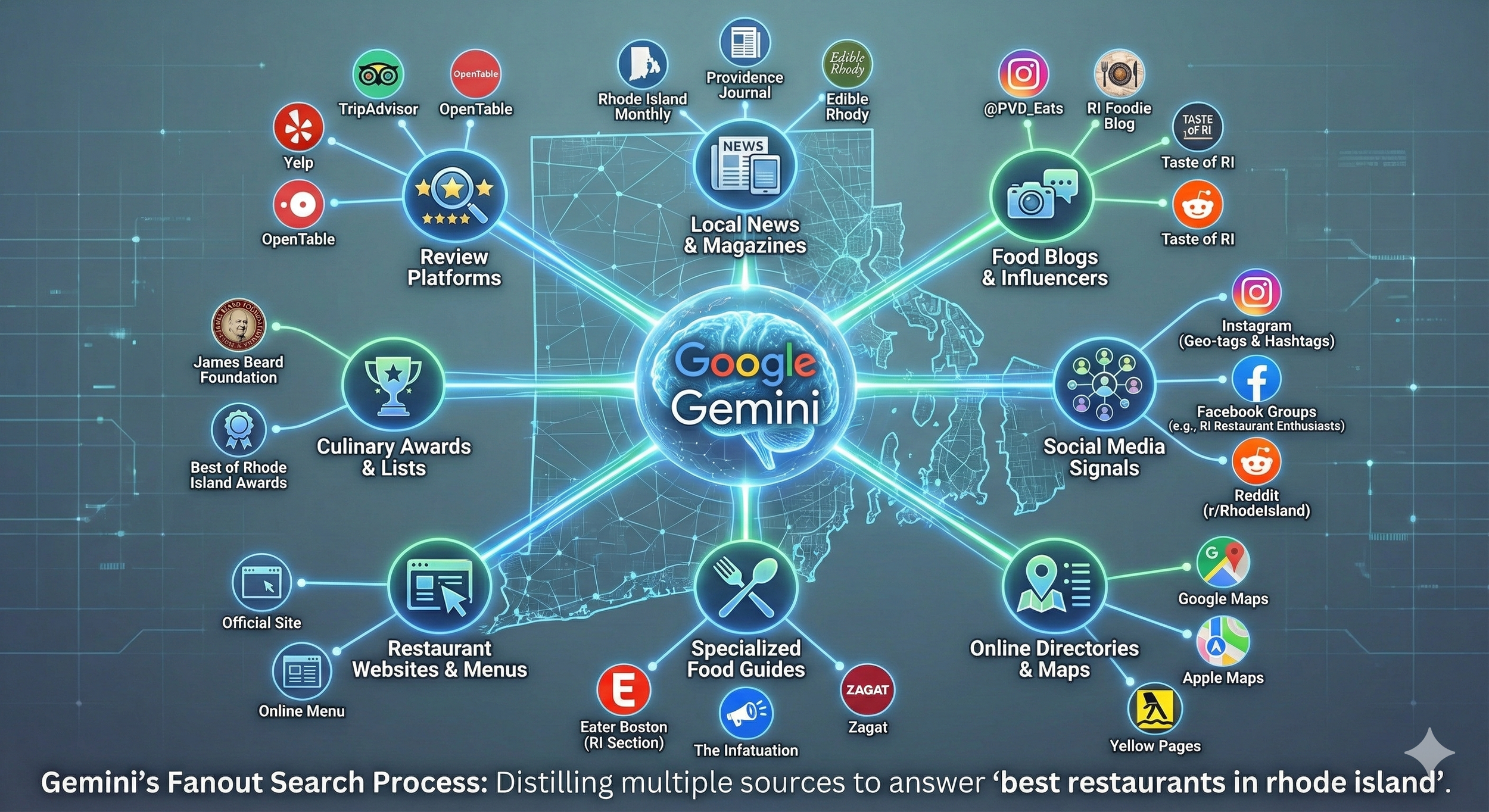
[custom illustration by Omni Search Labs - created using Google Gemini AI]
The Hub (The Brain): At the center is the AI, Google Gemini in this case. It receives the user's question and interprets its meaning. Since "best restaurant" is subjective, it needs to find consensus and facts. The AI looks for places that are open at the time of the search, have high ratings, are factual across different sites and platforms, and are endorsed by locals and visitors.
The Spokes (The Sources): To build its answer, the Hub reaches out to the specific trusted sources you see in the image:
The "Authority" Spokes (Awards & Media): The AI scans local experts. It looks at Rhode Island Monthly to see who won the "Best of Rhode Island" awards. It checks the Providence Journal for recent dining reviews. It even looks for national prestige, checking the James Beard Foundation list to see who has recently been nominated.
The "Consensus" Spokes (Reviews): It reads Yelp, TripAdvisor, and OpenTable. It isn't just looking for stars; it's reading the text to see if people mention specific dishes like Rhode Island "calamari" or "chowdah."
The "Vibe" Spokes (Social Signals): It checks Reddit threads on r/RhodeIsland or r/Providence to see what real locals are recommending to each other. This helps the AI avoid recommending "tourist traps" and find authentic spots like Mike's Kitchen in Cranston.
The "Reality" Spokes (Maps): Finally, it pings Google Maps to ensure the restaurant actually exists, is currently open, and is located where it says it is.
It only synthesizes the final answer after gathering this data from all these spokes. A response could look like: "For a special experience, try Oberlin in Providence. For a local favorite, consider Honeybird Kitchen in East Providence."
The "Broken Spoke" Problem
This visual shows why traditional SEO is more important than ever.
For example, if Google Gemini sends out a search party to check for "best of" awards or reviews, but the last review you received was years ago, the spoke returns not relevant. The same is true if it checks Reddit or OpenTable for the "vibe" and no one is talking about you. If it checks Google Maps and finds that your hours are different from other online sources, it will mark you as unreliable. See the risk?
If you don't rank on search engines, your chances of ranking on AI are slim. This is more relevant for local businesses than enterprise businesses ,like Ford Motor Company.
As you can see, AI relies on search engines' indexes to find businesses. If yours is invisible to Bing and Google's standard crawler because your technical SEO is poor, your content is short on meeting current standards, your site is slow, or your local business directory citation listings are out-of-date or inaccurate, the AI will likely just pass over you.
Not showing up on AI? Your business isn't being ignored by the AI bot. The bots see you. You’re being filtered out by the research process.
One Size Does Not Fit All: Industry-Specific Spokes
Although the above diagram uses a restaurant search as an example, it's important to understand that the strategy changes depending on your industry. For example, the AI knows that a "trusted source" for a pizza place is different from a trusted source for a machine shop.
If you are in manufacturing, healthcare, trades, or engineering, your "spokes" will look very different.
Manufacturing: The AI won't look at OpenTable or Yelp. Instead, it will search ThomasNet, ISO certification databases, and industry-specific trade journals to verify your capabilities and certifications.
Healthcare: The AI prioritizes trust signals from Healthgrades, Vitals, and board certification databases. It looks for consistency across insurance provider directories rather than relying on "vibe" checks on Reddit.
Trades & Construction: The AI validates your existence through the Better Business Bureau (BBB), the Rhode Island Builders Association, and local chamber of commerce directories.
Engineering: It looks for citations in professional societies, such as the Rhode Island Society of Professional Engineers (RISPE), and for technical white papers hosted on your website.
Many businesses fail here. They invest in a "generalist" strategy, a one-size-fits-all approach that treats precision manufacturers the same as coffee shops.
The pro tip here is to ensure that the strategy you invest in invests in you equally. It must be uniquely crafted for your business and digital ecosystem, not just a group of citations from Yext, BrightLocal, or other universal citation management software. When done correctly, citation management is a complex process that rewards effort, but many businesses and agencies take the quick route by using cheap link-building citation services.
A word of caution: Some services and agencies have created citations on the Baidu and Yandex networks, which are search engines hosted by China and Russia, respectively. For certain businesses and industries, this can be undesirable and may even lead to IP theft and national security concerns. Ask questions.
The Secret Weapon: Syndication and the EQUATE Score
One specific tactic separates the businesses that the AI recommends from those it ignores: Syndication.
At Omni Search Labs, we use the EQUATE writing framework to structure text-based content not only to meet, but also to exceed, Google’s EEAT framework by adding Quality and Uniqueness to the recipe.
Experience
Quality
Uniqueness
Authoritativeness
Trustworthiness
Expertise
Most businesses fail the syndication test because they only publish content on their "owned media," such as their blog, Facebook page, or LinkedIn profile. Rarely do they get their work published in online media outlets or industry publications, nor are they quoted, co-authored, or shared on other platforms. To an AI—and, let's be honest, to your readers, too—this looks like self-promotion. At best, it is an echo chamber.
To boost your EQUATE score, It’s critical you get published and syndicated on third-party platforms.
If you are a manufacturer: Don't just write a case study for your blog; get it published in Industry Week or a specialized trade journal.
If you are a restaurant: Don't just post your new menu on Instagram; get a food blogger to write about it or issue a press release that gets picked up by local news sites.
When the AI sees your business mentioned on other authoritative websites, it recognizes you as a verified entity rather than just a marketer. This third-party validation is one of the strongest signals you can send to the "Hub" (see the "Query Fan Out" graphic).
The Solution: Search Everywhere Optimization (SEvO)
This is why we advocate for Search Everywhere Optimization (SEvO). It is simply the next evolution of an SEO concept we’ve been practicing for decades.
Looking back at that Hub and Spoke diagram, you can see that your digital footprint is an ecosystem. To be the “answer” the AI gives to your customer, you must be present and optimized across every spoke of the wheel:
Search Engines: Your website must be technically sound so the Hub can read your menu and descriptions.
Review Sites: You need active, fresh reviews on the platforms that matter to your specific industry.
Local Media: You need mentions in local press (Providence Journal, RI Monthly) so the Hub can verify your authority.
Directories: You need accurate citations on business listings so the Hub knows exactly where you are.
Imagery: You need crisp professional photography and video (or high-quality phone content) so people can take a visual inventory of your business before investing their time.
Social Trust: Don’t forget the value of social proof that comes with a vibrant social media effort!
By strengthening your presence on these foundational non-AI platforms, you are effectively feeding the AI the data it needs to recommend you. AI isn't magic; it's a mirror reflecting the most authoritative content on the web. At Omni Search Labs, our job is to ensure that when the AI goes looking for answers, it finds you.
#RhodeIsland #SEO #MadeInRI #BeDiscovered