
Local SEO Services in Rhode Island
Google Maps, Citation Management, and Local AI Search Optimization
When nearby customers search for what you do, are you the first business they find? If not, you are losing qualified inquiries to competitors right when locals are ready to call, visit, or buy.
Local SEO ensures people in your actual service area find accurate, trustworthy information about your business at the exact moment they need you. Today, that requires far more than basic Google rankings. It demands coordinated visibility across Google Search, Google Maps, Apple Maps, Bing Places, local directories, voice search, in-vehicle navigation, and emerging AI answer engines.
Most agencies stop at claiming a Google Business Profile and building a few generic directory listings. For Rhode Island and Southeastern Massachusetts businesses competing in real towns and neighborhoods, that is not enough. Backed by 30 years of hands-on search experience (and having founded and marketed several businesses of our own), we deliver the deep local signals that make your phone ring.
Built on Real Authority
2025 Rhode Island Tech10 Award Winner
Founded by the 2025 Rhode Island Tech10 Award recipient for search innovation and recipient of the 2026 CV Technology Excellence Award for Best SEO Optimisation Specialists in New England.
30 Years of Local Business Ownership
Named a Top Tech Entrepreneur ("13 to Watch in Rhode Island") by GoLocalProv. Continuous commercial search practice in Rhode Island and Southeastern Massachusetts since 1997.
Institutional SME & Advisory Leadership
Formal SCORE Rhode Island Subject Matter Expert in search acquisition, technical curriculum advisor to the New England Institute of Technology, and former instructor at the Rhode Island School of Design. Pricing starts at $300 with zero retainers.
The Hyper-Local Strategy: Why Narrow Beats Wide
Many owners assume that attempting to show up across all of New England brings more opportunity. For most local businesses, that broad net quietly works against them.
If you are a plumber, your next customer is usually within twenty minutes of your facility. If you are a financial advisor, state licensing keeps you within defined boundaries and most clients live within a few towns. If you are a contractor, restaurant, medical practice, or retail store, your commercial success is decided in your own backyard.
The businesses that dominate local search do not cast the widest net. They go narrow and deep, fully owning their actual service territory. A contractor who dominates Cranston, Warwick, and West Warwick will almost always out-earn a firm that is spread thin with half-rankings across the whole state.
- Dominating the specific towns and ZIP codes where your customers actually hire you.
- Eliminating wasted spend and effort chasing geographic reach you cannot convert.
- Positioning your business as the obvious, trusted answer in the market you serve.
What You Actually Get When You Work With OSL
Your business appears where local buyers search, executed directly by a 30-year search veteran: never handed off to a junior coordinator.
I have sat in your chair as a business owner and founder. I know what it costs when a customer drives to the wrong address because a citation was outdated, or when an AI tool recommends a competitor down the road because their local signals were cleaner than yours.
With Omni Search Labs, your local presence is managed as part of a unified Search Everywhere Optimization (SEvO) strategy, not a generic "local package" that ignores broader search signals.
- Complete citation synchronization across Google Business Profile, Apple Maps, Bing Places, in-vehicle GPS, Yelp, and trade-specific directories.
- Consistent Name, Address, Phone, and website (NAP) validation that builds trust with search algorithms.
- Transparent monthly reviews tied directly to phone calls, foot traffic, and quote requests.
What Most Agencies Get Wrong About Local Listings and AI Search
Business listings are no longer just citations. They form the evidence layer that search engines and AI models evaluate before recommending your business.
The AI Fanout: How Answer Engines Discover Your Business
When someone asks an AI tool "Who is the best service provider near me?", the AI does not guess. It fans out across dozens of trusted sources: review platforms like Yelp and TripAdvisor, local media like Rhode Island Monthly and the Providence Journal, social consensus on Reddit, verified map records, and trade databases.
Think of your business as the central hub, and every verified directory listing, review profile, and local citation as a spoke. When an AI crawler checks those spokes and finds consistent, accurate data pointing back to your domain, it verifies your legitimacy and recommends you. When it uncovers conflicting data or missing spokes, it immediately recommends a competitor whose records it can verify.
These spokes vary across every industry:
- Restaurants: Depend on Yelp, regional food publications, and culinary awards.
- Contractors: Require the BBB, Rhode Island Builders Association, and municipal directories.
- Manufacturers: Rely on Nterprisers, ThomasNet, ISO certification databases, and trade journals.
- Medical Practices: Depend on Healthgrades, Vitals, and insurance provider networks.
For a technical deep dive on this process, read our full article on Connecting the Spokes: Why AI Needs SEO to Find You.
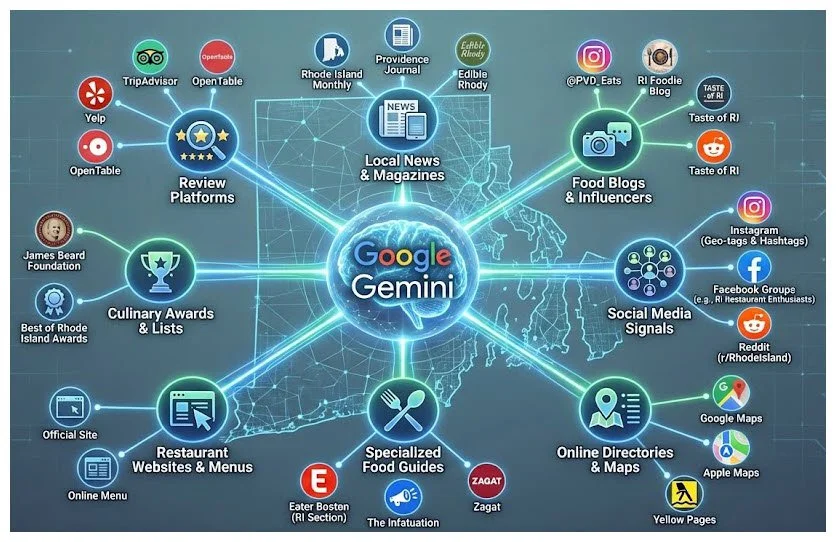 The Hub and Spoke Architecture: How Search Everywhere Optimization powers AI answers.
How Your Search Visibility Is Reviewed and Gaps Identified
Footprint Mapping
We audit your existing footprint across Google Business Profile, Apple Maps, Bing Places, Yelp, and industry-specific directories like Healthgrades, ThomasNet, or the BBB.
Consistency Verification
We verify that your business name, address, phone number, hours, and service categories are identical everywhere. Mismatches weaken search engine and AI credibility.
Trust Signal Audit
We analyze review quality, missing photography, broken links, duplicate entries, and algorithmic red flags that suppress local ranking positions.
Opportunity Identification
We pinpoint where your business is absent, targeting high-authority regional publications, chambers, and trade platforms to secure local citation dominance.
What Changes When Your Local Visibility Works
- Right-fit customers find you first: When someone in your area searches for a local contractor, doctor, or specialist, your business appears before competitors.
- Information is trusted everywhere: Consistent, synchronized listings across Google, Apple Maps, and Bing give AI answer engines the confidence to recommend your company.
- You lock in your service territory: Strong local search prominence establishes your firm as the default recommendation within your geography, compounding over time.
What Is at Risk If You Ignore Local Visibility
- Inaccurate listings quietly cost you sales: Missing or conflicting phone numbers and addresses silently turn prospective buyers toward competitors.
- Every lost search is a permanent lost customer: Local search failure does not trigger a warning: it quietly redirects high-intent callers to other businesses.
- No fallback geography for tight service radii: For businesses with a defined local radius, missing prospects in your immediate neighborhood means that revenue is gone forever.














Frequently Asked Questions
Direct answers about local search optimization, citation management, and review audits.
Is local SEO just business directory and citation work? +
No. Citations are the foundation, not the whole house. Complete local search optimization also encompasses your Google Business Profile, review architecture, on-page localized content, internal linking equity, and the structured entity signals that AI answer engines evaluate.
While clean directory data verifies that your business exists, content depth and local schema convince search algorithms to recommend your business over a competitor.
Will publishing more blog posts give my business more local visibility? +
Only if the content satisfies real buyer intent. Blogging contributes to local search when each article addresses specific local questions, regional case studies, or technical problems, meeting our proprietary EQUATE writing framework: Expertise, Quality, Uniqueness, Authority, Trust, and Experience.
Generic, unreviewed articles published simply to maintain volume do not move the needle on search engines or AI assistants. Treat every post like an authoritative resource a customer would bookmark.
My customers do not visit a storefront. Can you market a service-area business? +
Yes. Service-area businesses (such as plumbing, HVAC, electrical, contracting, and mobile consulting) represent a significant portion of our local search engagements.
We define your exact operating radius, tune your Google Business Profile to suppress physical residential addresses where appropriate, build local landing pages, and optimize citations so you appear as the obvious choice in the specific towns you serve.
How do you review and audit our existing local search visibility? +
Our review begins with an exhaustive footprint audit across Google Business Profile, Apple Maps, Bing Places, Yelp, and industry-specific directories. We check NAP consistency (Name, Address, Phone), review quality, duplicate listings, and image completeness.
Next, we identify technical gaps: missing high-authority regional citations, incomplete schema, and competitor advantages, providing a clear roadmap to secure your local market share.
Why is citation accuracy so critical for AI search and navigation systems? +
Conversational AI tools (like ChatGPT, Perplexity, and Gemini) and in-vehicle GPS systems pull data from verified public aggregators. If your phone number, suite number, or business name differs across directories, AI models detect the inconsistency as an untrusted signal.
Consistent citations provide the factual verification machines require to recommend your business with high confidence.
How does Local SEO connect to your Search Everywhere Optimization (SEvO) program? +
Local SEO is one of the foundational layers of our comprehensive Managed SEvO Services.
While standalone local optimization secures your immediate geographic footprint on maps and directories, our unified SEvO program integrates technical web architecture, commercial content development, and generative AI search visibility into a single coordinated system.
What does Local SEO cost at Omni Search Labs? +
Our Local SEO engagements start at $300 under a transparent, fixed-price model. We do not charge open-ended retainers, hourly fees, or agency management markups.
Pricing reflects the competitive nature of your market, your service radius, and the volume of citation remediation required. Review our Fixed-Price Project Menu for full details.
How long does it typically take to see results in Google Maps? +
Fixing duplicate listings, correcting inaccurate addresses, and optimizing primary Google Business Profile categories often yields early wins within 30 to 60 days.
However, achieving consistent top-three placement in competitive local map packs and earning permanent AI recommendations typically requires 3 to 6 months of steady optimization and citation verification.
This Is Right For You If
- Your business relies on local customers in your town, county, or service radius finding you fast.
- You have searched your business online and found incorrect addresses, old phone numbers, or listings you cannot control.
- A customer has told you they had trouble locating your business or finding your service options.
- Your state license, service radius, or business model keeps your market close to home.
- You want to be the business an AI assistant recommends when someone nearby asks for what you do.
- You want direct senior execution starting at $300 with zero agency retainers and zero junior handoffs.
Clarity Costs Nothing. Confusion Costs Everything.
A 30-minute SEvO Discovery Call is a straight conversation about your business: where you currently appear across Google, maps, and AI platforms, and which strategic fixes will actually move the needle.
If your local signals are already in good shape, I will tell you directly. If your business is not a fit for our model, I will point you toward someone who is.
No pressure. No jargon. No invoice on the other side of the conversation.