
January 2026 Rhode Island SEO News
January ‘26: SMB SEO & SEvO Trends That Matter for Rhode Island Businesses In 2026
AI-generated content with copywriting and editing by Chris Sheehy
This month, we’re taking a fresh plunge into January’s search shifts for small and mid-sized businesses in the Rhode Island area. We’ll look at how Google’s latest update sharpened its focus on helpful, human-centered content, why your Google Business Profile and entity signals matter more than ever, and how AI Optimization (AIO) is emerging as a practical layer on top of traditional SEO—not a replacement.
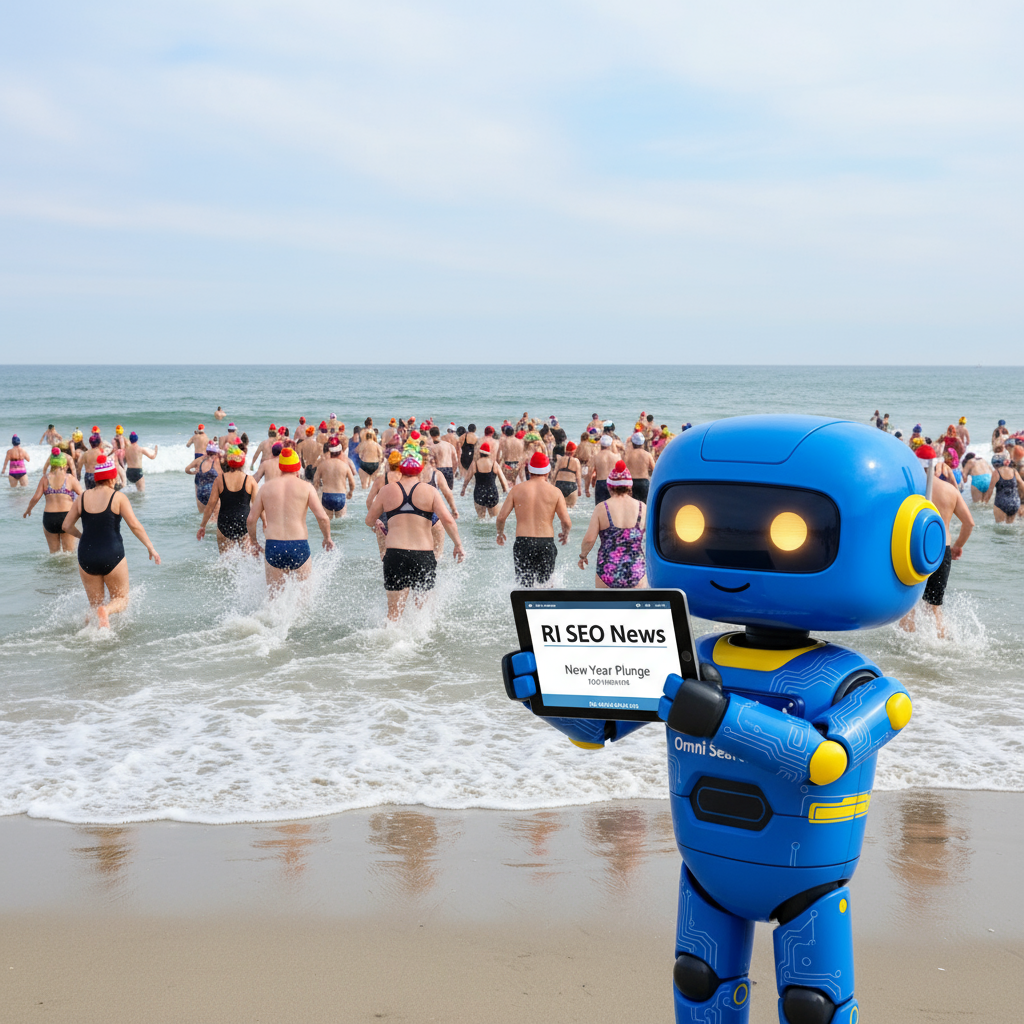
January 2026 was a pivotal month for search optimization. Google released multiple updates, and the search landscape continues to evolve in ways that are good news for small and medium-sized businesses—but only if they take advantage of it.
Let's review what happened, why it matters, and where you should focus your efforts this month.
The January Update: Google's Focus on Human-First Authenticity
On January 8, Google rolled out a significant update to its search engine that many industry observers interpret as placing an even greater emphasis on E-E-A-T - (Experience, Expertise, Authoritativeness, and Trustworthiness), consistent with Google’s guidance on creating helpful, people‑first content. This wasn’t a minor adjustment. It was a clear signal that Google prioritizes helpful, reliable information created to benefit people over mass‑produced, low‑value pages designed mainly to manipulate search rankings, regardless of whether they’re written by humans or with AI. In other words, Google is favoring content that demonstrates real experience and usefulness over shallow, filler content.
It’s important to note that the issue isn’t whether content is written with AI, but whether it is genuinely helpful, reliable, and trustworthy to real people who read it.
What does this mean for you? If you've been relying on mass-produced AI content or thin, generic pages, this update may have affected your rankings. However, if you've been establishing your business's authority through authentic customer stories, in-depth case studies, and genuine insights—content that is unique to you—you're probably experiencing positive movement.
The mid-month volatility (January 15–21) added another layer of change, with significant ranking fluctuations reported across sectors. This is normal after major updates and signals that Google is actively refining how it evaluates websites.
What to Do About It: Start auditing your content using the EQUATE writing framework. Omni Search Labs developed this framework as an expansion of Google’s E-E-A-T, adding quality and uniqueness to Google’s core writing standards.
Ask yourself the following questions for each important page:
Could this page be about any product or service, or does it clearly demonstrate your unique experience, process, and point of view?
Are the facts, statistics, prices, and technologies mentioned still current, or do they reference outdated tools, terminology, processes, practices, policies, or offers?
Compared with my top competitors, am I providing clearer and more helpful explanations, better comparisons, and stronger proof (photos, case studies, and reviews)?
When a layperson reads my pages, do they think they are promotional (selling my services or products), or do they find the answers to their search questions?
Then, pick three to five priority pages and:
Enhance existing content. Add questions that customers ask and clarify vague sections. Update screenshots, examples, and terminology to reflect your current operations.
Fill content gaps. Create new pages or blog posts where you don’t yet have strong coverage. For example, create service-area pages, comparison content, or buyer’s guides. Then, link them to your main service pages to strengthen your topical authority.
Improve internal linking. Look for opportunities in existing pages and blog posts to naturally link to your key offers (services or products).
Content that wins in 2026 doesn’t just “exist”—it evolves. Pages that are regularly refreshed, fact-checked, and expanded using an EQUATE-style standard are far more likely to survive core updates and earn visibility across traditional search results and emerging AI-driven experiences.
Local SEO Just Got More Precise—And That Benefits You
Local search continues to evolve, and one of the most evident trends this year is how Google handles "near me" and other queries indicating local intent. The algorithm relies heavily on proximity, relevance, and prominence, with an increasing emphasis on accurate and consistent business data. This is good news for Rhode Island businesses because it means that customers searching for your services locally are more likely to find you if your information is complete and accurate.
Your Google Business Profile (GBP) is now more than just an important directory citation. It's also a primary discovery layer for local searches, Google Maps, AI-generated answers, and many zero-click interactions, such as calls and direction requests. If your profile is outdated or inconsistent with your website and other directories, you’re likely missing out on visibility and conversions.
What should you do? This month, prioritize your Google Business Profile:
Make sure your business name, address, and phone number (NAP) are consistent across your website, Google, and key local directories. Inconsistent NAP data can confuse Google and weaken your local authority.
Your photos are current, high quality, and accurately represent your space, staff, and services. Listings with fresh, realistic photos tend to receive more engagement and are favored by AI-driven interfaces that surface "active" businesses.
Your primary and secondary categories are precise, not inflated to chase extra searches, which helps Google understand what you truly do and match you to better-qualified queries.
You add regular posts and respond to new reviews and Q&A to show Google and users that your business is active and well-managed.
Your hours, services, and pricing (where appropriate) are clearly displayed and kept up to date so users don't leave your site or report inaccuracies, which can negatively impact your business.
Here’s an advanced but critical tip: avoid moving your map pin or changing your address unless you're actually relocating. Significant changes to your location can reset or damage your local visibility. In some cases, they can even trigger suspensions if Google deems them suspicious (even if they are not). Getting your physical location right the first time and maintaining stability over time is one of the most underrated ways to protect your local presence.
For businesses in Providence, Warwick, Newport, New Bedford, and surrounding areas, consistency and stability are game changers. When a customer searches "plumber near me" or "best pizza in downtown Providence," Google considers your proximity, categories, engagement, and data accuracy; if your listing shows an incorrect address, outdated hours, or frequent location changes, competitors will benefit.
The Rise of AI Optimization: Preparing Your Business for AI Search
A major theme emerging this month is the rise of AI Optimization (AIO)—the discipline of helping AI systems understand, trust, and reuse your content across search, chat, and assistant experiences. AIO encompasses practices such as Answer Engine Optimization (AEO) and Generative Engine Optimization (GEO). These practices focus on how your content is selected, summarized, and cited in AI-generated answers, overviews, and chat responses. You can also consider emerging "agentic" optimization as part of this category—that is, the practice of tuning how AI agents select vendors, tools, and resources.
At Omni Search Labs, we group SEO, AIO, and SEvO (Search Everywhere Optimization) together as one connected ecosystem. SEO handles traditional search rankings; AIO, including AEO and GEO, focuses on AI-driven answers and assistants; and SEvO is the umbrella strategy that ensures your brand shows up wherever people search—not just in Google, but also in AI tools, maps, directories, social platforms, marketplaces, and more.
For day-to-day business conversations, you don't need to know all the acronyms. What matters is that your content is discoverable, trustworthy, and reusable across all these touchpoints.
Here’s the practical distinction: With traditional SEO, you’re competing for positions 1-10 on a search engine results page (SERP). With AIO, however, you’re competing to be the source that AI systems pull information from and cite when someone asks, "What's the best tool and die shop for prototyping near me?" "Who's the best website development company in Rhode Island?" or "How do I fix an ice dam on my roof?" Answer-focused engines increasingly consider clarity, structure, and entity consistency. They rely on structured content, business citations, and schema markup rather than simple keyword matches.
Even small-businesses that embrace AIO-style tactics are seeing outsized gains, such as appearing in AI overviews, voice assistant answers, and comparison-style responses, when their information is well-structured and richly described.
What should you do? Start with structured data and extraction-friendly content.
Write to the EQUATE standard: Create and update content that consistently demonstrates experience, quality, uniqueness, authority, trust, and evidence. Prioritize depth over volume, real examples over theory, and clear takeaways that humans and AI systems can easily recognize as helpful.
Dial in your schema (with entities first): Use structured data to clearly define who you are and what you do, prioritizing strong Entity/Organization and LocalBusiness (where applicable) schema. Then, layer in Service/Product and FAQ schema so that search and AI systems can reliably understand, connect, and reuse your content. And don’t forget to test it at https://validator.schema.org/ before moving on to the next step. I try to recommend DIY-able solutions that anyone cann do - but schema is probably worth outsourcing to a pro. OSL takes on one-off projects like this, let us know if we can help.
Invest in high-value citations: Ensure your business is accurately listed on a focused set of authoritative platforms, such as Google Business Profile, key industry directories like CB Insights, and trusted local and regional sites. Maintain perfectly consistent NAP and category information to reinforce your entity and location signals. And be sure to apply the EQUATE principles to citations!
The good news is that none of this requires a website redesign. It's about organizing and labeling your existing content with clean headings, answer-first paragraphs, clear entities, and high-quality schema so that both traditional search engines and modern AI systems can interpret and trust you as a source.
The Dual Path Forward: Traditional SEO + Search Everywhere Optimization (SEvO)
January 2026 marks a significant shift in the SEO landscape, solidifying the practical separation between traditional SEO and Search Everywhere Optimization (SEvO). SEvO recognizes that customers search for businesses in many places beyond Google Search, including social platforms, AI chat experiences, local and industry directories, review sites, and video and podcast platforms. Customers may find you through a TikTok search, a Reddit recommendation, an Instagram search, a Google review, or an AI assistant’s answer; they may never see a classic "10 blue links" results page.
For Rhode Island SMBs, visibility isn't just about ranking on Google anymore. It's about being discoverable wherever your customers search and make decisions, whether that's "best Italian restaurant on Federal Hill" on Maps, "website developers in Warwick" on an AI assistant, or "local CNC job shops" on a niche forum or LinkedIn thread.
What to Do About It: This month, run a quick audit.
Where does your target customer actually search (Google Analytics is one place to find this)? If you’re a restaurant, consider Instagram, Google Maps, and reviews. If you’re a B2B service, consider LinkedIn, Google, and industry directories. If you’re a retailer, consider Google, Maps, and the social platforms your buyers favor.
Are you consistently and accurately represented on those priority platforms?
Is your business information (name, address, phone number, description, photos, services/products, and reviews) consistent across all platforms, or does each profile contain slightly different information?
Are you actively responding to reviews, questions, and mentions on these platforms or letting conversations about your brand go unanswered?
You don't need to be everywhere; you need to be consistently present and trustworthy in the handful of places your best customers use to find, compare, and choose businesses like yours.
Zero-Click Searches: A Reframe, Not a Crisis
I want to address a common concern among business owners: "If AI overviews answer the question, why would anyone visit my website?"
The reality is that they still do, just differently. Now, a large share of searches end in what we call "zero-click" behavior, where users find enough information in the search results or AI answers that they don't need to visit a site. However, visibility in AI answers and SERP features is still valuable. When an AI assistant recommends your business or your content powers a featured snippet, local pack, or FAQ panel, it's a conversion opportunity—just happening on the results page instead of your homepage.
Local businesses can benefit especially. A "near me" search might not generate a website visit, but it could prompt a phone call, request for directions, or decision to walk in—and that's still a win. In other words, not every successful outcome shows up as a pageview.
What to do about it: Stop measuring success solely by website traffic. In 2026, pay close attention to:
Branded search volume: Are more people searching for your business name plus your city or neighborhood?
Google Business Profile actions, such as calls, direction requests, website clicks, and message/chat starts.
AI and SERP visibility: How often are you cited or recommended in AI answers, overviews, or other rich results, even when clicks are low?
Phone call and form conversions that originate from the local pack and Maps results.
Customer questions and leads coming through Google Q&A, reviews, and other on-platform messaging.
These are the new leading indicators of local success in an AI- and zero-click-heavy world. They often tell a more accurate story about how well you’re showing up where buyers make decisions.
Personal Brand & Authenticity: Your Competitive Advantage
I’m passionate about this: In an age of AI-generated content, your authentic voice is one of your most valuable business assets. This renewed emphasis on authenticity and real-world expertise is an opportunity for owners and managers willing to share their actual experience instead of generic talking points.
You don’t need to become an influencer. It simply means you:
Share case studies and short success stories from real clients (with permission—which you can bake right into your contracts or statements of work).
Write about the challenges you’ve solved and the lessons you’ve learned.
Answer the questions your customers ask, using their own words and phrasing.
Share your differentiators—for products or services—without disclosing trade secrets.
Stay consistent in how you communicate across your website, social channels, email, and your Google Business Profile.
When Google—and increasingly, AI systems—see that you have real expertise, real customers, and a track record of delivering results, that trust signal compounds across all your visibility efforts, including rankings, reviews, and recommendations.
What to do about it: This month, pick one area where you have clear, differentiated expertise. It could be how you serve a specific niche, a process you’ve developed that gets better results, insights into local ordinances or compliance, or a hard problem you solve better than your competitors do. Create a page, section of a page, or blog post about it - as well as a Google Business Profile update, or a LinkedIn article—that expresses your unique perspective. Keep it specific, story-driven, and true to how you actually work.
ProTip: Share that page or blog post across all your social media channels for the broadest impacts!
Practical Action Plan for February
If all of this feels overwhelming, here’s a simple, four‑week plan you can actually follow—one focus per week, in order of impact:
Week 1: Lock in your core business data
Verify NAP consistency (name, address, phone) across your website, Google Business Profile, and 3–5 high‑value directories.
Fix any discrepancies immediately, including old addresses, legacy phone numbers, or outdated categories.
Confirm that your primary categories, service areas, and hours accurately reflect how you operate today.
Week 2: Elevate your Google Business Profile
Refresh your business description so it clearly explains who you are, what you do, and who you serve—using the same language your customers use.
Add or update photos that show your space, team, work, or products as they look now (not five years ago).
Review services, products, and attributes to ensure they are complete and accurate, then respond to any recent reviews or Q&A you haven’t addressed.
Week 3: Make your site AI- and search-friendly
Add or refine your schema: prioritize Entity/Organization and LocalBusiness schema, then layer in Service/Product and FAQ schema where it makes sense.
Create or enhance an FAQ section that answers real customer questions concisely, in their words, and structure those answers so both people and AI can easily understand and reuse them.
Check that your key pages have clear headings, answer‑first paragraphs, and straightforward URLs that reinforce who you are and what you do.
Week 4: Refresh your content to EQUATE
Identify your 3–5 highest‑value pages (by traffic, leads, or revenue influence) and review them through your EQUATE lens: Experience, Quality, Uniqueness, Authority, Trust, and Evidence.
Update outdated references (tools, pricing, processes), expand thin sections with real examples or mini case studies, and remove filler that doesn’t genuinely help a reader make a better decision.
Add internal links from relevant blog posts or resource pages into these refreshed pages to reinforce topical depth and guide users (and AI systems) toward your best content.
A closing thought for Rhode Island SMBs
January 2026 isn’t a crisis—it’s a clarification. Search and AI platforms are effectively saying, “We want real expertise, consistent information, and authentic answers.” For business owners and managers who actually know their craft and care about their customers, that’s an advantage, not a threat.
The landscape is shifting from keyword games to authority, consistency, and authenticity across SEO, AIO, and SEvO. For Rhode Island and nearby businesses willing to show up as the knowledgeable, trustworthy experts they already are—and to signal that clearly in their data, content, and presence everywhere people search—these changes are an opportunity to pull ahead while competitors who rely on shortcuts quietly fall behind.
