
March 2026 Rhode Island SEO News
AI-generated content with copywriting and editing by Chris Sheehy
March was one of the most volatile months we've seen in search in a while—especially for local businesses that depend on Google Maps, reviews, and AI-powered discovery. Between a spam update, a new core update, and continuing shifts toward AI and zero-click results, the ground moved under everyone's feet.
The good news: the businesses that win from these changes look a lot like the kind of shops, contractors, clinics, and professional services we have across Rhode Island and Southern New England—real companies serving real people.
The bad news: "set-it-and-forget-it" SEO and incomplete Google Business Profiles are getting punished more aggressively than ever. And not focusing on the nuances of Bing Search Engine SEO is limiting visibility across some AI platforms. As we've noted before here on the Omni Search Labs blog, the research firm SearchPilot found that businesses that pause or neglect SEO can expect organic traffic to decline by as much as 10–20% in the first year alone, with continued erosion compounding in every year that follows. That isn't a fringe warning — it's a measurable, documented pattern that applies to local businesses just as much as national brands. If you've been wondering whether your current SEO investment is actually pulling its weight — or whether it makes sense to start — our free Web & SEO ROI Calculator lets you plug in your own numbers and see exactly how many sales it takes to break even and hit a real return. No signup. No sales pitch.
#WhereIsOmniBot?
Here are the big headlines for March 2026:
Google rolled out a global spam update (around March 24) and began a broad core update on March 27, targeting low-quality, spammy, and "generic AI" content while rewarding pages that add genuinely new information and clear expertise.
Local search (Maps and the 3-pack) became even more sensitive to Google Business Profile (GBP) completeness, review recency, and owner response behavior, not just review count or old citation work.
Zero-click results and AI Overviews continue to reduce classic website clicks; studies show more than half of searches end without a visit to any site, and AI Overviews appear in a minority of local queries but are growing in influence.
AI assistants (Gemini, ChatGPT, Perplexity, Copilot) recommend a tiny fraction of eligible local businesses—often between about 1% and 11%—making AI visibility several times harder than ranking in Google's local pack.
Bing reached 10.48% U.S. search market share—its highest share ever recorded—driven largely by ChatGPT and Microsoft Copilot's AI integration, making Bing optimization a meaningful lever for local discoverability - so stop ignorinig Bing as part of your SEO strategy!
Short-form video and social platforms (Instagram Reels, YouTube Shorts) continued to grow as search tools, with a majority of younger shoppers discovering local businesses on social platforms before verifying via Google or Maps.
Below, I'll unpack what changed, why it matters for local SMBs in and around Rhode Island, and what to actually do in April.
1. March 2026 Google updates: what changed
What Google shipped
March 2026 spam update (completed quickly around March 24). This targeted spammy and low-quality content, especially thin pages, keyword-stuffed copy, and manipulative link patterns.
March 2026 core update (began March 27, still settling into early April). This global update recalibrates ranking systems for all industries and languages and is designed to reward more helpful, reliable content.
Independent analyses highlight a few specific shifts:
"Information gain" is now a primary signal. Pages that simply rephrase what's already in the top results—especially AI-assisted content with nothing new added—are losing ground to pages with original data, firsthand experience, or unique perspectives.
AI-generated content is under stricter quality filters. Sites that use AI as a drafting assistant with strong human editing and real examples tend to be stable or up, while sites pumping out generic AI pages at scale are seeing significant drops.
User intent matching is tighter. Pages that technically mention a keyword but don't fully address what the searcher is really trying to do are being outranked by pages that solve the whole problem, including the "next question" a user would naturally ask.
What this means for Rhode Island SMBs
If your rankings moved in late March, the cause is less likely a "penalty" and more likely that Google now considers other sites more helpful or original for certain queries.
For local businesses, this usually plays out in:
Service pages that are too generic ("We're your trusted plumber in Rhode Island") losing to pages that show photos of local jobs, pricing expectations, and common local issues (old housing stock, coastal weather, etc.).
Blog posts that repeat well-trodden topics without adding your own data—like "Top 10 SEO tips" written by AI—sliding in favor of posts with local stats, real stories, and screenshots from your own tools or process.
Action steps for April (site & content)
Identify 5–10 key money pages (services, locations) and ask: What is on this page that nobody else in my market can say? If the answer is "not much," plan to add real examples, photos, numbers, and FAQs.
Audit any AI-assisted content created in the last 12–18 months. Rewrite or consolidate thin, overlapping articles into fewer, deeper guides that include your own perspective and data.
For each core service, make sure your page addresses the full task: problem, options, pricing expectations, timeframe, risks, and what happens next—so users don't have to bounce back to Google for follow-up questions.
2. Local SEO shake-up: GBP/BPB are the new homepages
Several data sets this month confirmed something I've been telling clients for years: your Google Business Profile is effectively your homepage for local search.
What changed in local
Analyses of the March core update's local impact show:
Google Business Profile (GBP) and Bing Places for Business (BPB) completeness is now a stronger ranking lever. Profiles missing services, hours, photos, attributes, or Q&A content are seeing measurable drops in local pack visibility, especially in competitive categories like legal, medical, home services, and restaurants.
Review recency and response rate overtook raw volume. Businesses with lots of old reviews but little recent activity are dropping behind competitors that have a steady trickle of new reviews and respond quickly to them.
Proximity weighting is more aggressive. For "near me" service queries, distance to the searcher is carrying more weight, especially when other signals (ratings, completeness) are similar between competitors.
Engagement signals matter more. Calls, direction requests, website clicks, and photo views from GBP/BPB are increasingly used as behavioral signals of relevance.
In practice, this means a fully built-out, frequently updated profile with strong, recent reviews will often outcompete an older, better-known brand that hasn't touched its GBP/BPB in years.
Key local signals and what to do
SignalWhat changed in March 2026What to do this monthGBP completenessMissing fields now act more like a penalty than a missed bonus.Fill in every relevant field: categories, services, attributes, Q&A, hours, photos.Reviews (recency & responses)Newer reviews + fast owner responses now outweigh sheer volume.Aim for a few new reviews weekly; respond to all reviews within 24–48 hours.ProximityDistance weighs more when other signals are similar.Clarify service areas; use city-specific pages to support nearby towns.EngagementCalls, clicks, directions feed into local relevance.Add compelling photos, offers, and posts that encourage interaction.
Action steps for April (Google Business Profile)
Run a GBP/BPB completeness audit: categories, description, services, hours (including holiday hours), attributes, products/menus, photos, and Q&A. Close every obvious gap.
Implement a simple review program: one follow-up email or text per customer, with a direct review link and clear instructions; make it a process, not an ask of last resort.
Block 30 minutes twice a week to post on GBP: updates, offers, seasonal reminders ("AC tune-ups before Memorial Day"), or community involvement. Profiles posting every few days are correlating with better local visibility.
3. Zero-click and AI search: winning without the click
Search behavior continues to tilt toward answers on the results page instead of clicks to websites.
Studies of zero-click search show:
Roughly 58–60% of searches in the U.S. and EU now end without a click to any external site, with projections that this could exceed 70% by mid-2026.
Local and branded queries are especially prone to zero-click behavior, as users get phone numbers, directions, hours, and reviews directly from SERP features and Maps.
AI Overviews currently appear in a minority of local-intent queries—about 7% of local searches in one recent analysis—but their influence is outsized when they do appear.
Separately, a major local visibility index found that AI assistants recommend only around 1.2% of locations on ChatGPT, 11% on Gemini, and 7.4% on Perplexity, compared with brands appearing in Google's local 3-pack about 35.9% of the time—meaning AI visibility is 3–30x harder to achieve.
What this means for you
You can't judge success purely by "organic sessions" anymore. For many local businesses, winning means owning the search experience, not just the click:
Being the business shown in the 3-pack, Maps, and AI Overviews.
Having accurate, compelling snippets (hours, pricing cues, photos, review excerpts) that convince people to call or visit without ever touching your website.
One practical and commonly overlooked gap: if your website's clickable phone number isn't properly formatted, it may be silently failing for VoIP callers, Microsoft Teams users, and visitors on non-US devices — with no error on their end and no signal in your analytics. We covered exactly this, and the 5-second fix, in Is Your Website Phone Number Link Silently Failing? — worth checking before you drive any more traffic to your site.
Action steps for April (zero-click & AI-readiness)
Treat SERP presence as a product page: make sure title tags, meta descriptions, schema, and GBP/BPB text clearly communicate who you are, what you do, where you do it, and why you're a safe choice.
Add FAQ/Q&A content to key pages and your GBP, using natural language questions and short, clear answers. AI Overviews and assistants lean heavily on structured, conversational Q&A.
Prioritize structured data (LocalBusiness, Service, Product, FAQ, Review) so Google and AI tools can confidently extract and quote information about your business.
Check your phone number link formatting now — one broken tel: link can silently drain calls without a single error message.
4. Bing and Microsoft Copilot: the underrated visibility channel
Most small businesses put every optimization dollar into Google and treat Bing as an afterthought. That's an increasingly costly oversight — and March 2026 makes the case harder to ignore.
Why Bing matters more than you think
Bing hit 10.48% U.S. search market share in February 2026 — its highest recorded share ever — driven by a three-point gain in the past 12 months. On desktop specifically, Bing commands roughly 27–28% of the U.S. desktop search market, a critical detail for any business whose customers research services from a work computer. That's one in four desktop searches that never touches Google.
The bigger story is what's powering that growth: Microsoft Copilot. When Microsoft embedded generative AI into Bing, it became the first major search engine to do so — and that first-mover advantage is showing up in the share data. Microsoft just rolled out additional Copilot updates in late March 2026, including a multi-model "Critique" feature that cross-checks responses using both GPT and Anthropic's Claude for accuracy before delivering them to users.
Here's the piece that directly affects Rhode Island businesses: ChatGPT pulls local business data directly from Bing Places for Business. When a potential customer asks ChatGPT "What's the best HVAC company near me in Cranston?" or "Who are the top estate attorneys in East Providence?" — the underlying business data that populates those answers comes from Bing, not Google. A missing or incomplete Bing Places listing is, functionally, invisibility in ChatGPT local search.
Microsoft also relaunched Bing Places for Business in October 2025 with a redesigned interface, improved data accuracy tools, and a clear signal of deeper Copilot integration ahead. That relaunch is worth treating as a starting gun.
The Bing Places–ChatGPT connection in plain English
Think of it this way: if someone asks Siri for directions, Apple Maps is the data source. If someone asks ChatGPT for a local business recommendation, Bing Places is the data source. Optimizing your Bing listing isn't just about Bing searches anymore — it's a direct feed into one of the most widely used AI assistants in the world.
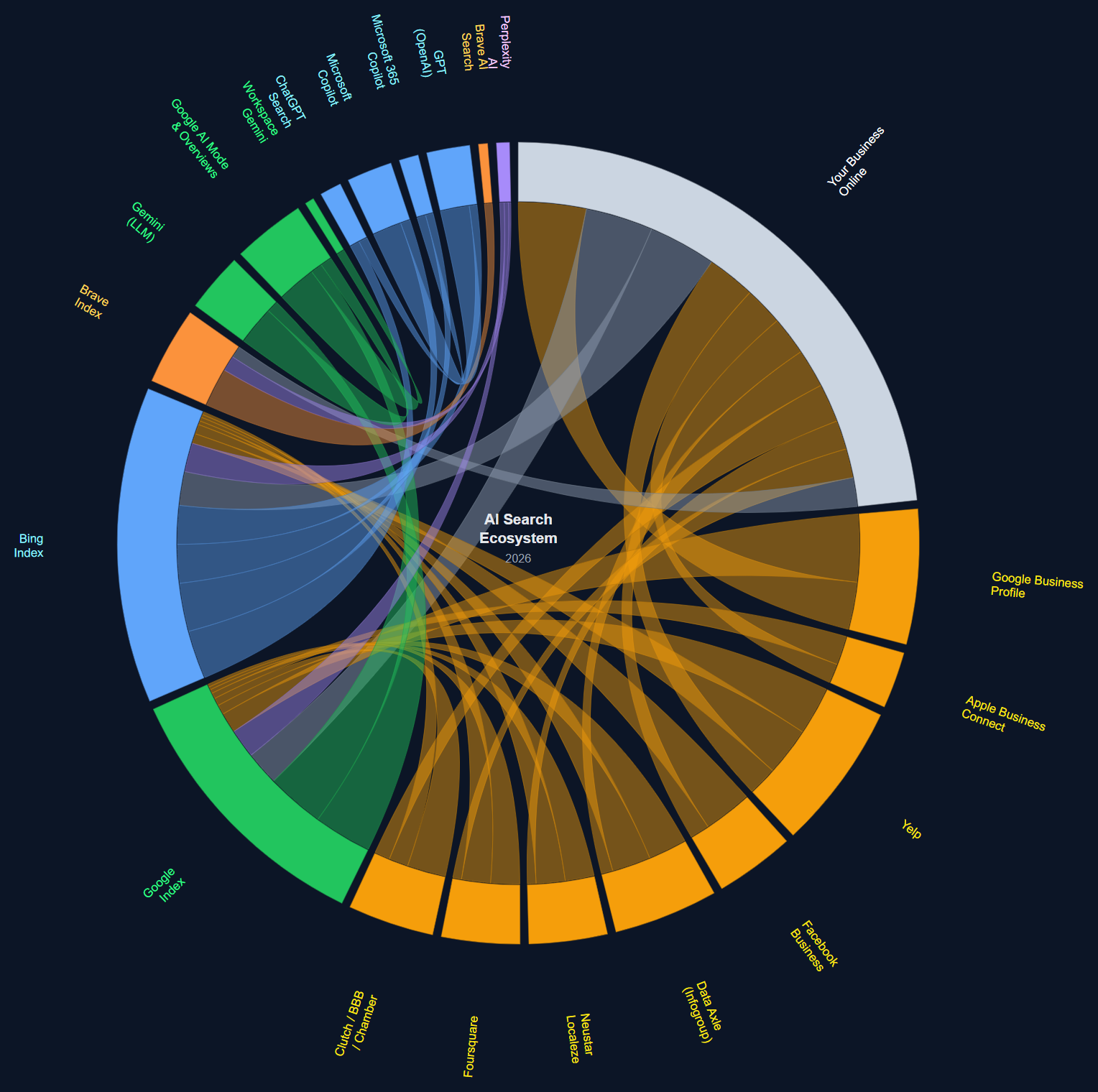
AI Search Ecosystem 2026 - click for interactive tool
To see how Bing, Google, GBP/BPB, citations, and AI assistants all connect into a single data ecosystem, take a look at our AI Search Ecosystem Map (2026) — a visual we built to show exactly how information flows from your listings through search indexes and out to the AI surfaces your customers are actually using.
Action steps for April (Bing & Microsoft Copilot)
Claim and complete your Bing Places for Business listing at bingplaces.com if you haven't already. The platform now allows direct import from your Google Business Profile — it takes about 15 minutes and is free.
Verify NAP accuracy on Bing (name, address, phone, website, hours, categories). Even a slight mismatch between your Bing listing and your website can create confusion for AI tools pulling from that data.
Treat Bing Places with the same discipline as GBP: add photos, describe your services clearly, select accurate categories, and keep hours current. What's in your Bing listing is what ChatGPT may serve to prospective customers.
Connect Bing Webmaster Tools (free, at bing.com/webmasters) to monitor how your site appears in Bing's index. Submit your sitemap, review crawl errors, and check keyword performance — data that complements what you see in Google Search Console.
If you're running paid campaigns, Microsoft Ads can import directly from Google Ads, often delivering lower CPCs against the same intent-based audience via Edge, Outlook, and Microsoft 365.
5. SEvO in practice: search is happening everywhere
Search Everywhere Optimization (SEvO) is the idea that people are now "searching" across a mix of channels — Google, Maps, AI assistants, Bing, Instagram, YouTube, and review platforms — and your job is to be discoverable and trustworthy wherever they look.
The data from the last year makes that shift impossible to ignore:
Gen Z discovery is overwhelmingly social. Multiple studies show a majority of Gen Z shoppers discover products and services on social platforms first, then move to websites or stores afterward.
AI assistants are now mainstream discovery tools. Consumers increasingly phrase queries conversationally — "Who's a good local roofer near Providence?" — expecting a direct recommendation, not a list of blue links.
Bing's growth is AI-driven. The same audience using Microsoft 365, Copilot, and Edge is searching Bing by default — and that's often the same professional and homeowner demographic that hires contractors, attorneys, accountants, and healthcare providers.
For a Rhode Island contractor, dentist, restaurant, or niche retailer, that increasingly means:
Prospects might discover you on Instagram Reels or YouTube Shorts,
Verify you via Google and Maps,
Then ask ChatGPT or Copilot for a second opinion — which pulls from Bing,
Then call or book through your site.
Action steps for April (SEvO channels)
Pick one short-form video channel — Instagram Reels or YouTube Shorts — and commit to 2–3 videos per week answering questions you already get from customers: pricing expectations, timelines, "how this works," local issues.
Make sure your name, address, phone, and website are consistent across Google, Bing, Facebook, Instagram, and major directories. This NAP consistency is now a ranking signal for both traditional search and AI platforms.
Repurpose your best-performing educational content into YouTube Shorts and embed them on service pages; video-rich pages tend to stand out in both SERPs and AI summaries.
6. April checklist for Rhode Island SMBs
Here's a concrete checklist you can drop into your project plan for this month.
Website & content
Identify your top 5–10 money pages and add at least one of the following to each: local examples, before/after photos, ranges for pricing/timelines, or short case snapshots.
Merge or prune thin, overlapping "AI-ish" blog posts; replace them with 1–2 deeper, clearly authored guides that include your own data or perspective.
Add an FAQ section to each key service page, using real questions your customers ask in email and on the phone.
Google Business Profile & local
Complete a full GBP/BPB audit and fill every reasonable field: categories, services, description, attributes, hours (including holiday hours), service areas, and photos.
Implement a review playbook: ask every satisfied customer, ideally while they're still in front of you or just after work is completed; respond to all reviews within 48 hours.
Post at least one GBP update per week (offer, tip, seasonal reminder, behind-the-scenes), and track calls and directions from GBP as a key metric.
Bing & Microsoft Copilot
Claim and complete your Bing Places for Business (BPB) listing; import from GBP if you haven't set it up yet so it’s in sync with GBP changes - but be sure to also individually optimize BPB listing - the import from GBP is not a 100% coverage solution!
Connect Bing Webmaster Tools and submit your sitemap to ensure your site is fully indexed and crawlable on Bing.
SEvO & off-Google discovery
Choose one video channel (Instagram Reels or YouTube Shorts) and commit to a realistic posting cadence — 1–3 short videos per week that answer common questions or show your work.
Make sure your name, address, phone, and website are consistent across Google, Bing, Facebook, Instagram, and major directories — this consistency is now a ranking and AI-visibility factor.
Measurement
In GA4 and Google Search Console, create simple "watch lists" for your core service queries and local pages so you can see how March's updates are playing out over the next 4–6 weeks.
Add Bing Webmaster Tools alongside GSC in your monthly reporting routine; it surfaces keyword and crawl data that Google doesn't always show.
Track calls, direction requests, and messages from GBP alongside website traffic; these are often the first things to move when Google tweaks local rankings.
If you're a small or mid-sized business in Rhode Island or nearby and you're seeing ranking turbulence, lead quality issues, or confusing trends in GA4 after March, these are the levers to pull first. The winners in this new environment won't necessarily be the biggest brands — they'll be the businesses that keep their profiles complete, their content genuinely helpful, and their presence strong in the places customers actually search.
More From the Omni Search Labs
New resources worth bookmarking:
AI Search Ecosystem Map (2026) — new blog post & reource tool — An interactive visual showing how your website / blog, GBP, Bing Places, citations, and website flow through search indexes and out to AI surfaces like Gemini, ChatGPT, and Copilot. Inspired by the original Local Search Ecosystem by David Mihm in 2009(ish) but re-built for the AI era.
Is Your Website Phone Number Link Silently Failing? — new blog post — One small line of code can cause your clickable phone number to fail for VoIP users, Microsoft Teams callers, and non-US devices — with no error message and no missed-call alert. Includes a five-second check and an easy fix.
Web & SEO ROI Calculator — new page resource tool — Free, no-signup tool. Plug in your average sale value, close rate, and current SEO investment to see exactly how many sales you need per month to break even and hit a real return. Built for SMB owners who want numbers before proposals start flying.
