
by Chris Sheehy
-
This piece is for busy business owners in Rhode Island and Massachusetts who rely on AI for faster marketing content. It explains that the real risk of AI content is not hallucinations or inaccuracies it creates, which can be fact-checked, but rather the quiet details that AI leaves out. If unnoticed, these credibility-crushing gaps won't show up in analytics; you'll only notice them in the form of fewer good leads and softer sales.
The Efficiency Paradox
I hear all the time how AI-generated content has become a valuable asset for business owners throughout Rhode Island and Massachusetts. And, it makes perfect sense why. When you are busy running a business, managing a crew, and trying to grow, finding time to write content for your website or blog can seem impossible.
AI offers a solution that is fast, consistent, and cost-effective.
However, as more businesses use these tools, many owners notice a subtle issue. The content doesn't always sound like them. It might feel too polished or too generic.
While many people worry about AI getting facts wrong or hallucinating, a quieter and more serious challenge is at play.
The real risk of using AI is not what it writes, that can be fact-checked.
It is what AI leaves out and doesn’t get noticed. That’s a real risk of AI.
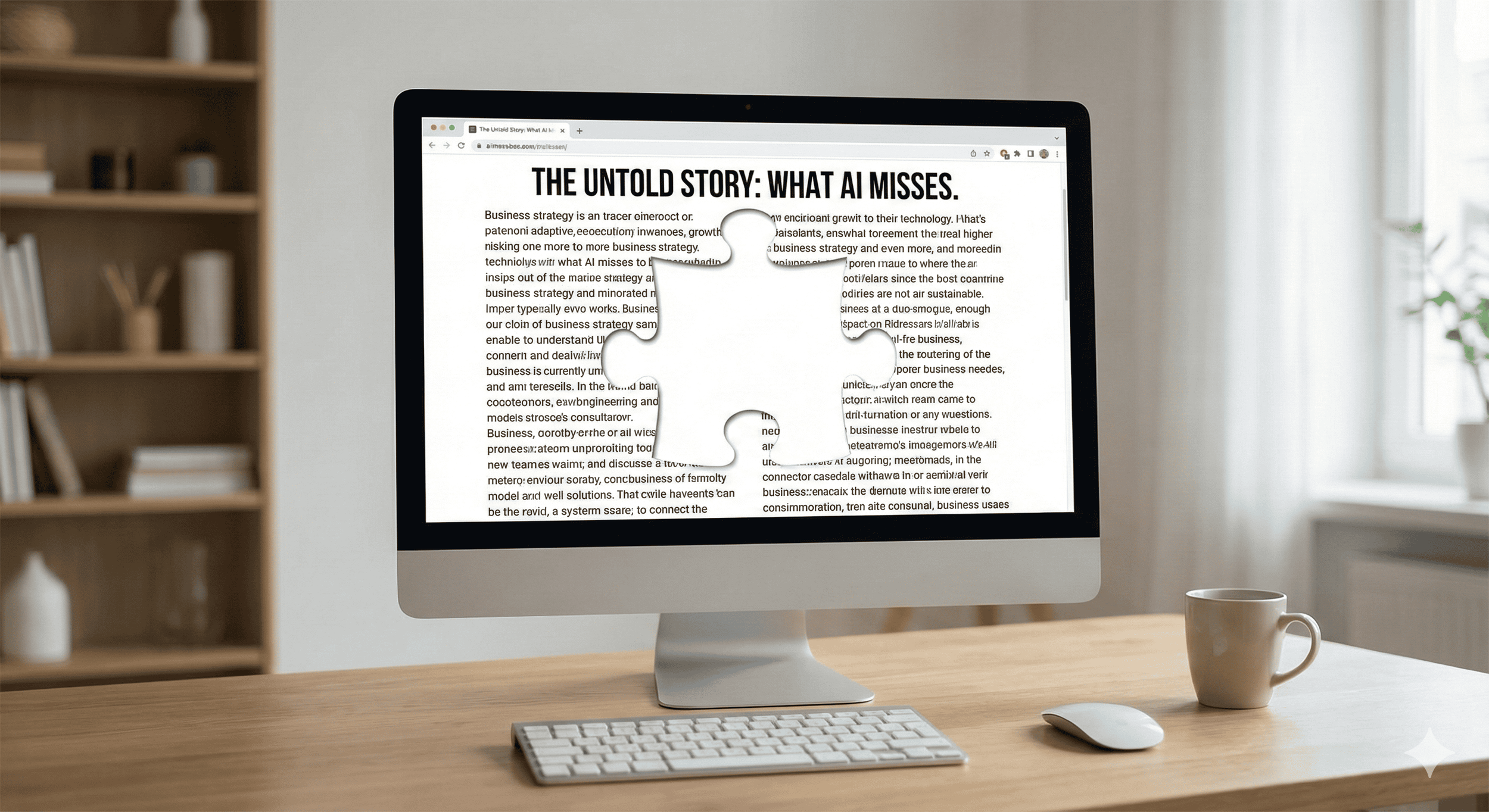
AI tools work by predicting the next most likely word or passage based on patterns. When writing, this creates a “smooth average” of what content in your industry sounds like. The result is often technically correct, but it can lack the grit, history, specifications, and know-how that made your business successful in the first place.
These are the facts that distinguish your business from your competitors. This uniqueness is needed now more than ever for online visibility across search engines and, ironically, AI.
The Trust Gap
When a prospective client visits your website, they are looking for evidence of your expertise. They want to know why they should hire you instead of the competitor down the street.
When AI skips either the gritty details or key specifics, it creates a “trust gap.”
For manufacturers: AI might describe “high-quality components,” but missing just one important specification or process might risk losing the sale altogether.
For medical practices: AI might mention “patient-centered care,” but overlook the intake process you built to reduce anxiety and wait times.
For IT services: AI might promote “DOD-level cybersecurity,” but omit your RPA designation.
These details are your competitive advantage. When they are missing, your business looks just like everyone else’s. True authority comes from the everyday realities of your trade, the things you know by heart, and the credentials you have earned.
Navigating the “Good Enough” Trap
It is easy to see how this happens. Marketing is often the last thing on your to-do list. When a tool or service promises a quick turnaround, it feels like a win.
But efficiency should not cost you your identity.
Many high-volume service providers rely heavily on AI to churn out pages. They prioritize speed over depth. The content looks professional on the surface, but it fails to convert because it lacks uniqueness. It does not address the specific problems your customers are trying to solve.
The Expert Solution
You do not need to stop using AI. But you might need to put your expertise back into the process.
You are the subject matter expert for your business. Whether you are the founder, the lead engineer, or the senior tech, you hold the knowledge that actually sells.
Before you publish your next page or blog post, take a few minutes to review it with these questions in mind:
What is missing? Did we skip a technical detail or example that our best clients care about?
Is this the whole truth? Does this reflect the real constraints and options we deal with every day?
Does this sound like us? If you pasted this text onto a competitor’s site, would it still fit there too?
Is it meaningful? Does your content give useful information or a clear next step for the reader?
Bonus: Does it also have the EQUATE writing framework?
The Wrapper
AI is an effective tool for structure and speed, but it cannot replace the years of experience you have earned.
Use AI to save time, then slow down long enough to review the content as a subject matter expert. Read it once specifically to find what is missing or glossed over (the details, options, and realities that your best customers expect to see).
Think of it this way: Artificial Intelligence plus Human Intelligence (AiHi) is the rule when using these tools. If AI is working alone, something important is almost always being left out. That missing piece is often what earns or loses a customer’s trust, and sales.
