
SEO Guide for Rhode Island Manufacturers
When the Right Buyer Searches, Be the Shop That Comes Up
Procurement engineers, plant managers, and OEM buyers don't find suppliers the way they did ten years ago. If your website hasn't kept up with how they actually search, you're losing quotes you should be winning.
A Conversation I Have All the Time with Rhode Island Manufacturers
But first, a definition: search engine optimization (SEO) is the work of making your website easy for Google and Bing to find, understand, and recommend, so the buyers searching for your capability find your shop instead of a competitor's. This guide covers what that work looks like for manufacturers specifically, and where it now overlaps with the AI tools procurement teams increasingly use to research suppliers.
They tell me their work is excellent. Their tolerances are tight. Their lead times beat the competition. Their long-time customers love them. And yet, new buyers — the ones searching from Hartford, from Worcester, from a procurement office in Indiana — never seem to land in the inbox. The phone rings less than it did three or four years ago. The shop floor is busy, but the future pipeline feels thinner than it should.
When we look at the website together, the story almost always lines up. The pages list machines, materials, what they do, and certifications. Everything technically true is there. But the page doesn't answer the questions a buyer is actually asking before they pick up the phone, and the search and AI tools buyers use can't recommend a shop they can't understand.
That's the gap this page is about. It's also a gap I've closed before.
The Orbetron Story — Proof by NIST That This Works in Rhode Island Manufacturing
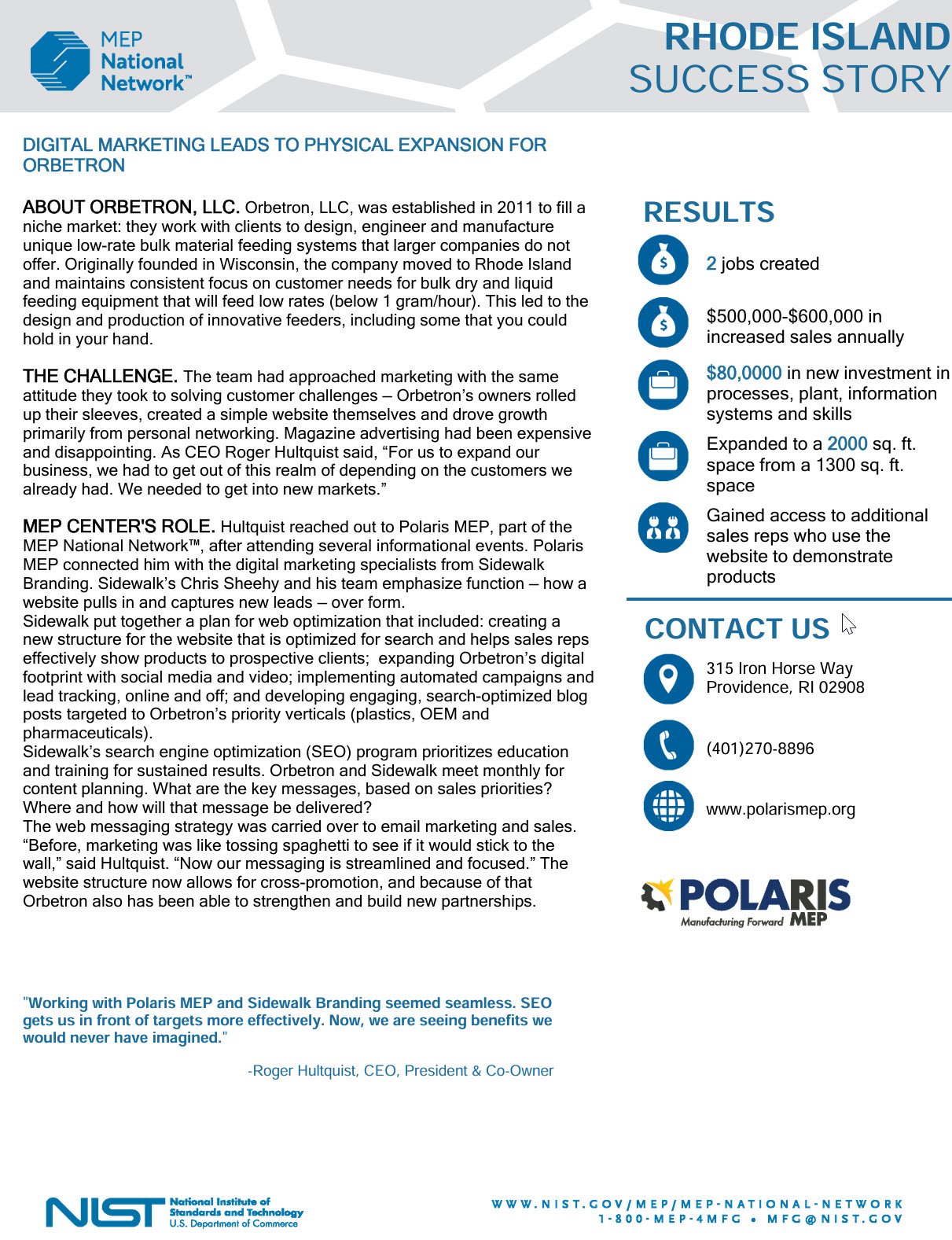
A few years before I founded Omni Search Labs, I led the digital strategy for Orbetron, a precision feeding equipment manufacturer right here in Rhode Island. The work was executed under my previous agency, Sidewalk Branding Co., before it was acquired in 2022. The strategy, the execution, and the 30 years of experience behind those results are the foundation OSL is built on.
Polaris MEP, Rhode Island's federal manufacturing extension partner, identified Orbetron as a company with world-class engineering but a digital footprint that wasn't reaching the procurement engineers who needed to find them. They brought me in.
We didn't redesign the website. We didn't add a marketing budget the company couldn't justify. We built a strategy around the way procurement engineers actually search, and around the proof signals buyers and search tools use to decide which manufacturers belong on a shortlist.
What followed got Orbetron published by the National Institute of Standards and Technology as a national success story:
$500,000 to $600,000 in new annual sales, directly attributed to the digital work.
A 54% increase in manufacturing footprint to handle the new volume.
Two new full-time positions added.
A sales team that uses the website as a primary tool to demonstrate capability to global clients.
That's not just a marketing case study. That's a P&L outcome with NIST's name on it.
The Specialist Outsourcing Model, Applied to Your Website
You already run parts of your own operation this way. A shop that does its own machining still outsources heat treating or plating to a supplier that's spent decades getting good at exactly that one process, because trying to do it in-house would mean being mediocre at a second trade instead of excellent at your first one. You stay in charge of the part. The specialist handles their piece of it. The part comes out right.
Search and AI visibility deserve the same arrangement, and most manufacturing websites never get it. What usually happens instead - SEO arrives as a line item on a website build — a short list of starter keywords, a handful of meta-tag edits, a passing mention of schema markup, a confident promise about traffic. A spike in the first three to six months as the easy wins land. Then a slow, quiet slide that nobody on the project sees because nobody's still measuring. By the time a business notices the phone and form submissions have gotten quieter, the original team has moved on to the next website project, and the manufacturer is told they need a website refresh to fix it.
The same dynamic plays out when the work falls to "Bill from IT" or "Jill, the owner's niece who just graduated." The skills are real. They aren't the right skills for this work — asking either of them to run your search and AI visibility is the same as asking them to run a process on the shop floor they've never been trained on. They care, they'll try, but it's a specialist's job done part-time by a generalist, and the slide is the predictable result. Search visibility benefits from someone who's spent decades tracking platform changes (Google alone has rolled out roughly a dozen major core updates since 2022, each with hundreds of smaller changes buried inside it) and who catches a slow decline before it becomes a bad quarter.
The same logic applies to the AI tools a lot of owners are now using to do this work themselves. ChatGPT, Gemini, Perplexity, and Claude are genuinely useful accelerators in the hands of someone who knows what to ask, what to verify, and what to discard. They aren't specialists. Their output reflects the average of what they were trained on, delivered with the confident tone of an expert whether the answer is accurate, partially right, or invented outright — the digital equivalent of a mechanic confidently telling you your truck needs blinker fluid. You can act on it. It will cost you something. This isn't an anti-AI position — I use AI every day, as an accelerator on early drafts and pattern recognition. The judgment, the editing, and the final word stay with a human who knows the industry.
If your current web developer is genuinely good — and a lot of them are — this isn't a reason to replace them. It's a reason to put the specialist work in specialist hands while they keep doing what they do best.
Six Places Manufacturing Websites Quietly Lose the Quote
Here's where that gap actually shows up, in the order I typically find it. Even if you've already signed with someone else, these are worth reading so you can ask them better questions.
You're competing against the wrong list. Ask a manufacturer to name their online competitors, and the list is usually three or four shops the owner knows personally — the one in Cranston, the one across the line in Fall River, maybe a New Bedford shop that keeps poaching an engineer. The problem is that the search results a procurement engineer sees aren't built from that list. Results are personalized, adjusted by location, device, and browsing history. The list on the owner's phone, built from years of clicking on known competitors, isn't the list a procurement engineer in Hartford sees. A real competitive view starts from outside your personalization bubble and surfaces the names you've never heard of, the ones quietly taking quotes that should have come to you.
You're optimizing for what you want to be found for, not what buyers are actually searching. The owner says "precision machining." The buyer searches "Swiss screw machining .0005 tolerance 17-4 stainless." The owner says "fabrication." The buyer searches "TIG welded stainless food-grade hood New England supplier." That gap between owner language and buyer language is where most manufacturing websites lose visibility. Real keyword research, pulled from Google Search Console, Bing Webmaster Tools, and the AI assistants, shows what buyers are actually typing. Demand modeling goes one step further, estimating whether there's enough real search volume in a specific region for a specific capability before you invest in ranking for it, critical for start-up shops and for established manufacturers that have lost penetration in a target market.
You're chasing the highest-volume keywords instead of the ones with real intent. "CNC machining" has high volume, hundreds of national competitors, almost no buyer intent, and zero geographic specificity, a page-one ranking for it would still produce almost no qualified quote requests. The opposite mistake is picking keywords just because they're long, on the theory that more words means less competition. Neither wins work. What works is the actual phrases that produce quote requests - specific capabilities, certifications buyers verify before they call, and regional and industry-specific qualifiers. Shorter list. Much higher conversion.
Your website is running as a brochure instead of your best salesperson. If you've ever said "our work comes from word of mouth," "we get our business from RFPs," or "our website has never gotten us work," there's almost always one of two reasons - the site was never built to generate leads (weak calls-to-action, no conversion paths, analytics not tracking what matters), or it got a one-time SEO push at launch and nothing since. In both cases, the business has functionally fired its best salesperson and is propping up the gap with personal hustle, referrals, and trade shows. A properly built site works around the clock, without a salary or a bad week. If word of mouth is your primary lead source in 2026, it isn't because your industry doesn't search online, it's because the buyers who would have found you online didn't. And if you think RFPs make you immune to this, they don't. Buyers frequently build their bidder shortlist by searching online before an RFP is ever issued, and companies often get invited to bid because a procurement engineer found them first, not the other way around. If your shop isn't visible in that early research phase, you're not being excluded from RFPs, you're being excluded from the list of companies who get asked to submit one.
AI is being used for convenience where it should be used for speed. Owners are running ChatGPT to identify competitors, asking Gemini for keyword ideas, letting AI draft website content or entire websites. The instinct is honest, AI is fast and cheap, and a specialist feels expensive by comparison. What doesn't get mentioned in the pitch - the data behind that confident answer is sometimes stale, sometimes pulled from an outdated directory, sometimes invented outright, delivered with the same confident tone regardless of which is true. Ask a professional writer in your industry to review AI-drafted content and they can spend an hour listing what's missing, the specific tolerances that prove you understand the work, the lived details that separate a real manufacturer from a stock-photo version of one. Those are exactly the details search engines and AI platforms use to decide whether your shop earns a citation.
AI/AIO and SEO are being treated as side skills. SEO arriving bundled into a website build, or falling to whoever on staff has the most exposure to it, produces a spike in the first six months that looks like the program is working, followed by a slow decline nobody's measuring until quote requests are noticeably down a year later, by which point it's been compounding the whole time. Traditional SEO and AI optimization aren't two separate jobs, they're two parts of the same finish, like paint and primer sold separately versus a single product engineered to do both. If a provider is billing "AI optimization" as a new line item on top of SEO you're already paying for, ask them why your site wasn't already built to be read by AI crawlers in the first place. I broke this down further in Bridging the Gap Between Traditional SEO and AI Optimization.
Why Finding a Manufacturer Online Is Nothing Like Finding a Restaurant
Many companies selling "SEO" treat every business the same. A coffee shop, a law firm, and a precision shop get the same generic package. For a manufacturer, that's the fastest way to stay invisible to the buyers who actually matter. A procurement engineer isn't using Facebook, TikTok, or Yelp, and doesn't care how many followers or stars a business has — those signals don't align with their industry. What they're doing is verifying, quickly and quietly, often with two browser tabs open, that your shop can hit their tolerance, deliver to their timeline, and survive their compliance audit.
Here's where that verification actually happens:
ThomasNet — as much as it might make you cringe, it's still the dominant B2B platform engineers default to when they need to source quickly. The leads can be hit-or-miss, and most owners have a complicated relationship with it. It's still on the list whether we like it or not.
Nterprisers — a newer, Rhode Island-rooted platform built specifically for manufacturers, suppliers, and procurement leads. It doesn't have the decades of credibility ThomasNet has yet, but it's owner-first, free to claim, and growing quickly throughout the Northeast — worth watching.
SAM.gov and CMMC certification status — for defense and federal contractors, registration in the System for Award Management and your Cybersecurity Maturity Model Certification (CMMC) level are baseline verification points before a buyer even considers you. CMMC Level 2 third-party certification becomes a mandatory requirement in a growing number of DoD contracts starting November 2026. If that applies to your shop, it's worth addressing now, not after a bid you can't submit.
ISO and AS9100 certification databases — to verify what your site claims about quality systems.
Trade publications — IndustryWeek, Manufacturing.net, MEM Magazine, American Machinist, The Manufacturer, and Engineering.com.
Industry association directories — the National Association of Manufacturers (NAM), the American Chemistry Council (ACC), the Association for Manufacturing Technology (AMT), the Fabricators & Manufacturers Association (FMA), Polaris MEP, the Rhode Island Manufacturers Association (RIMA), and others.
Your own technical pages — capability descriptions, materials guides, and tolerance specs written as web pages, not buried inside PDFs that don't show up in search and nobody downloads.
If those sources are weak or missing, a buyer's research stalls before it ever reaches your inbox, even when your work is genuinely the best in the region. I broke the broader mechanics down in Connecting the Spokes: Why AI Needs SEO to Find You if you want the deeper read.
What a Buyer Is Really Asking When They Look at Your Site
A procurement engineer reviewing your site isn't testing whether you can list services. They're testing whether you understand their problem at the level of detail that earns a quote. For a Warwick precision shop, that means the website needs to read like the shop floor, not a brochure — specific materials, specific finishes, specific industries served, specific quality systems. "We machine to tight tolerances" tells a procurement engineer nothing they can act on. Explaining how you hold a tight tolerance on a specific stainless component, what fixturing you built to do it, and which industries you've delivered that part for earns the call — and generic "we do it all" copy doesn't just fail to impress a buyer, it actively pushes search tools to recommend a competitor whose pages sound more specific.
They're also reviewing ten supplier sites in an afternoon and don't have time to decode marketing language. They need capabilities, certifications, industries served, lead times, and geographic reach, in that order, without scrolling past stock photography first. Behind the scenes, every page also carries schema markup - code that tells Google, Bing, ChatGPT, Gemini, and Perplexity what the page is actually about. On most manufacturing sites, it's either missing or left at the bland default that came with the template. Hand-coded schema, built page by page for each capability and industry served, is one of the quiet edges most small and mid-sized manufacturers don't have, and neither do their competitors. The first shop to fix it wins. (OSL's process here is service-marked, so I won't go into more detail than to say the standard schema your website platform or plugins provide, while not useless, is a better-than-nothing product. You deserve better.)
And underneath that, especially in regulated industries — aerospace, medical, defense, food processing — buyers are looking for proof before they invest the time in a conversation - visible certifications, named leadership, real case studies with named industries even when client names stay confidential, and quality-system documentation that proves the shop is a real operation with depth. The proof that carries the most weight is never the kind you write about yourself — a published NIST case study, a Polaris MEP recognition, a trade publication feature, a verified ThomasNet or Nterprisers listing carry far more weight with both buyers and AI tools than anything a shop says about itself.
What Changes When This Work Is Done Right
Procurement engineers searching for your specific capability find your shop first, not a competitor's — and the work you're already doing on the floor becomes the work that closes new business online.
Your website becomes the sales tool your reps actually want to use. Capabilities, certifications, and project examples are organized so a buyer can verify a fit in two minutes, not buried in files they never download.
When a buyer asks ChatGPT, Gemini, or Perplexity for "precision machining in Rhode Island," your shop starts coming up by name — the modern version of being on a shortlist before the buyer ever calls a competitor.
Inbound quote requests get more qualified, because buyers arriving through specific technical content already know your capabilities fit.
The work compounds. A well-built capability page keeps earning quotes for years, unlike a trade show booth that resets every quarter.
What's at Stake If This Isn't Addressed
The buyers who don't find you don't tell you. They quote three other shops, place the order, and move on. The first you hear about it is when a long-term customer mentions a name you'd never heard of being the new supplier.
Real-world decline patterns tracked by SearchPilot show what happens when a site goes untouched, not a flat, steady loss, but one that accelerates — roughly 13%, then 20%, then 30% in a single bad year in their primary tracked case, with other tracked sites averaging a 12-13% decline per year. A manufacturing website that hasn't been meaningfully updated since 2022 or 2023 has likely already lost a real chunk of its visibility, and that loss compounds every year it stays untouched. I broke this pattern down further in SEO Decay.
AI tools lean on most of the same signals Google does, plus a few of their own. A shop slipping in Google is usually invisible in ChatGPT, Gemini, and Perplexity at the same time, and most owners never think to check. Recovery costs more than maintenance, once a competitor establishes the authority for "precision machining Rhode Island" or "medical device fabricator New England," displacing them takes longer and costs more than building the position would have cost in the first place.
This Is Right for You If:
You're a Rhode Island or southeastern Mass manufacturer — precision machining, fabricated metal, electronics, medical device, food and beverage equipment, jewelry, tooling, textile, or chemical processing. This also covers job shops, contract manufacturers, and businesses doing subassembly, process finishing (heat treating, plating, anodizing, painting), or other supportive work for larger OEMs, even if your customer is another manufacturer rather than an end buyer.
Your shop floor is busy with long-term customers, but new account growth has slowed or flattened.
B2B buyers in your target industries are finding your competitors online and you can't figure out why your shop isn't being named.
Your website lists machines and materials but doesn't read like the shop floor, and you suspect it isn't telling the story a buyer needs to verify a fit.
You've never had a real digital audit specific to manufacturing, or the one you had came back as a generic checklist that didn't fit your website or your buyers.
You'd rather invest in a foundation that compounds for years than another trade show booth that resets every quarter.
How I Work With Manufacturers
The work is the work. No software product, no offshore content farm, no junior account manager. You work with me directly — Chris Sheehy, founder, 30 years of experience, and a published NIST case study in this exact industry. Here's what an engagement actually covers.
Discovery and Technical Audit — a full technical SEO audit (crawlability, indexing, site architecture, page speed, Core Web Vitals, mobile usability, structured data) delivered as a written findings document with prioritized fixes. A competitive whiteboard analysis naming your real online competitors, including the ones you've never heard of. A current-state visibility report across Google, Bing, ChatGPT, Gemini, and Perplexity, corrected for personalization. A baseline KPI (key performance indicator) snapshot in GA4 (Google Analytics 4), Search Console, and Bing Webmaster Tools, with conversion tracking configured to measure quote requests, capability-sheet downloads, and form submissions against revenue.
Keyword and Demand Strategy — real keyword research pulled from actual buyer queries, not a wishlist. Demand modeling for your specific capabilities and target geographies, so we know there's real search volume before investing in ranking for it. An intent-driven keyword map prioritizing real buyer intent over vanity volume. A buyer-language reconciliation that aligns your site's phrasing with the technical and commercial language B2B buyers actually use.
On-Page and Content Work — a capability-page strategy deciding what to build, refresh, or retire. Page-by-page content development for capability, equipment, certification, and industry-served pages — I sit down with your team, pull out the specifics that matter (materials, processes, tolerances, certifications), and shape that into pages. AI helps me move faster on first drafts; every word that publishes is reviewed and finalized by me, then by you, and nothing goes live without your sign-off. Title tags, meta descriptions, headings, and image optimization coordinated with the keyword strategy. Hand-coded JSON-LD schema using the types that map to manufacturing — Manufacturer, Product, Service, Organization, LocalBusiness, and FAQPage. Internal linking that connects capability pages to industry pages to case studies the way search tools and AI assistants expect.
Local and Authority Work — a full Google Business Profile build-out with categories, services, products, posts, photos, and Q&A. A hand-curated citation network across the directories that actually matter for manufacturing — ThomasNet, Nterprisers, the Rhode Island Manufacturers Association, your industry association, and any specialty databases relevant to your certifications. No generic Birdeye, BrightLocal, or Yext citation automation. Review schema so the reviews you've already earned display correctly in search and AI results. I don't run review acquisition campaigns — review quality has to come from your customer relationships.
AI Search Optimization — the entity, authority, and citation work that gets your shop named when a buyer asks an AI assistant for your specific capability. Content formatting so AI tools can read, extract, and cite your pages accurately. Authority-signal building across the third-party platforms AI tools weight most — trade publications, association directories, certification databases. Pro-tier AI tooling and custom assistants built for your shop and your target buyer queries, pulled against your live data.
Conversion and Reporting — conversion rate optimization for the pages that drive quote requests, including form rendering and key-event conversion tracking. A redirect strategy for legacy URLs so search equity doesn't leak out the back of the site. A plain-English KPI dashboard showing visibility, rankings, quote-request conversions, and which pages and keywords are driving the most business. Month-over-month reporting at first, moving to quarterly year-over-year once there's enough history, paired with a standing working call to review the data and adjust the plan.
Ready to See Where Your Shop Stands?
The first step is a free 30-minute manufacturing discovery call. I'll show you where your business currently shows up across Google, Bing, and AI tools for the queries that actually drive procurement decisions in your industry, and where the gaps are quietly costing you quotes. If your visibility is already in good shape, I'll tell you that too. Schedule a discovery call
A Few Common Questions
Q: Do you only work with precision machining shops?
No. I've worked with manufacturers across beverage, chemical, electronics, equipment, fabricated metal, food, heat-treating, jewelry, machinery, medical devices, processing, textile, tools, and wood products. The specifics shift to match the industry, but the underlying discipline is the same.
Q: Will you replace our existing web team or marketing agency?
It depends on what you want. If you have a web team or developer you trust and want to keep them, I work alongside them, focused only on getting your shop found by the right buyers, not on redesigning what they built. If you're on WordPress and tired of paying the ongoing cost of updates and security patches, I also design and build websites on Squarespace, with the SEO and AI visibility work built in from day one. I design and develop specifically on Squarespace; I don't build on every platform, but I handle search and AI optimization on any platform you're already using. If you'd rather stay on your current platform and don't have a team in place, I can recommend trusted partners for that build too.
Q: Do you write the content, or do we have to provide it?
Both, depending on the engagement. I sit down with your subject-matter experts, pull out the specifics that matter to a buyer, and shape that into pages. You review every draft before it goes live. Nothing publishes without your sign-off.
Q: How long does it take to see results?
Some fixes can show up within weeks. The bigger gains, where buyers start finding you for the work you really want, typically build over six to twelve months and keep compounding. The Orbetron results took about eighteen months of consistent work to reach the level NIST published.
Q: What if we're already on ThomasNet and getting some leads from it?
Good — that's a foundation, not a finish line. ThomasNet is one place buyers look, and the leads can be uneven. AI tools, traditional search, trade publications, association directories, and newer platforms like Nterprisers are others. If you're only showing up in one place, you're missing the rest of the room.
Q: What's the difference between SEO and AIO?
SEO is being found in traditional search results — Google, Bing, the map listings. AIO is being found and recommended by name inside answers from ChatGPT, Gemini, Perplexity, Claude, and Google's AI Mode. They overlap substantially. They aren't the same. A shop doing well in one and not the other is missing a growing share of buyers either way.
Glossary
A few terms used above, in plain English:
Procurement engineer — the buyer-side technical decision-maker most likely to be the first contact when a new opportunity opens. Their search behavior is verification-driven, technical, and platform-aware.
Google Business Profile (GBP) — the free Google listing that controls how your business shows up in maps, "near me" results, the local pack, knowledge panels, and AI answers. The single highest-leverage listing in this category.
Local pack / map pack — the three local-business results Google shows above the regular search results for queries with local intent. Showing up here is the difference between getting called and not.
AI tools / AI assistants — ChatGPT, Google Gemini, Perplexity, Claude, and Google's AI Overview and AI Mode. They answer questions directly and often recommend businesses by name, instead of just listing links.
SEvO — Search Everywhere Optimization. The combined strategy of being visible across search engines you know, like Google and Bing, as well as AI like ChatGPT, Gemini, Perplexity, and even maps, and for voice searches — all of it, instead of just one of them. This work includes both SEO and AIO.
SEO — Search engine optimization. The work of making a website easy for search tools like Google and Bing to find, understand, and recommend, so buyers find your shop instead of a competitor's.
AIO — AI Optimization. The work of getting your shop discovered and cited as a source across AI platforms like ChatGPT, Claude, Google AI Overview, Gemini, and Perplexity. You'll hear related terms like Generative Engine Optimization (GEO), Answer Engine Optimization (AEO), and Large Language Model Optimization (LLMO) — these are subsets of AIO, like paint and coatings: different names, same underlying work.
Schema markup (structured data) — code added to a web page that tells search and AI tools exactly what the page is about — the capability, the industry, the certification, the location. Hand-coded schema outperforms platform defaults by a wide margin.
JSON-LD — the specific format Google and AI tools prefer for schema markup. The technical implementation behind hand-coded schema.
Citation / directory listing — a mention of your business on a third-party platform like ThomasNet, Nterprisers, Polaris MEP, or an industry association directory. Consistency across listings is one of the strongest signals you're a real, verifiable shop.
Demand modeling — research that estimates whether there is real search volume in a specific geographic area for a specific capability before you invest in ranking for it.
Core Web Vitals — Google's measurements of page-loading speed, interactivity, and visual stability. A slow website loses visibility regardless of the other work done on it.
E-E-A-T — Google's standard for what makes a webpage trustworthy: Experience, Expertise, Authoritativeness, Trustworthiness. The framework search tools use to decide who to recommend.
EQUATE — my expansion of E-E-A-T, adding Quality and Uniqueness, the two pieces I most often see missing. Covered in detail in Quality & Uniqueness: The Missing Ingredients to E-E-A-T.
HITL-AI / Human-Led AI — Human-in-the-Loop AI. I use AI to scan and accelerate the early stages. The judgment, the decisions, and the final version stay in human hands.
KPI — key performance indicator. The specific numbers (visibility, leads, conversions) used to measure whether the work is actually paying off.
GA4 — Google Analytics 4, Google's free platform for tracking website traffic and visitor behavior.
PPC — Pay-per-click. The plain-English term for online paid ads, like the ones that appear at the top of Google and Bing search results through Google Ads and Microsoft Advertising.