
Google Drops FAQ Schema. Viva la Schema!
By Chris Sheehy

Long Live Schema!
When Google officially ended support for "FAQ rich results" on May 7, 2026, a wave of predictable panic hit the digital marketing world.
If you hire an agency or manage a search visibility team, you might have seen this unfold. For years, adding specific code behind a website’s Frequently Asked Questions (FAQ) section would make drop-down question menus appear right under your listing on Google search results. On May 7, Google turned those drop-down boxes off for almost every business website.
To many freelancers and agencies, that was a signal to stop doing the work. Their logic was simple: If the visual reward on Google is gone, why bother writing FAQ content or adding the background code?
That reaction misses the big picture. Looking back at Google's May update, it didn't render FAQ code useless - it simply separated visual candy from true machine understanding.
Here’s why keeping FAQ schema on your website is still a good idea for getting your business found by search engines, AI bots, and your next clients.
Display vs. Machine Understanding: The Label on the Bag
To understand why this code still matters, it helps to understand what "schema" actually is without getting bogged down in programming jargon.
FAQ Schema is simply a translation layer. It is structured code added to a webpage that helps search engines, AI systems, and other machines understand the relationship between content on a page. In the case of FAQ Schema, it tells those systems: "This text is a question, and this text is the corresponding answer."

Think of it like a bag of chips.
Your website design is the colorful front of the bag that attracts a human customer. The schema markup is the "Nutrition Facts" panel on the back. It doesn't change what's inside the bag, but it clearly labels and organizes the contents so anyone inspecting it can understand exactly what they're looking at.
When Google retired the familiar FAQ rich result drop-downs that once appeared prominently in search results, many website owners and SEO teams interpreted the change as a signal that FAQ Schema had lost its value. Some stopped implementing FAQ markup. Others abandoned FAQ sections altogether.
The reality is that Google changed how FAQ Schema is displayed, not what structured data is designed to do.
At Omni Search Labs, we view schema as a communication tool rather than a visual enhancement. Its value has never been limited to generating a special search result appearance. Its primary purpose is helping machines understand the content that already exists on a page.
That distinction matters more today than ever.
Modern search engines, AI assistants, and large language models are constantly attempting to identify authoritative answers to user questions. Well-structured FAQ content helps present those answers in a clear, organized format. When supported by appropriate schema markup, that structure becomes even easier for machines to interpret.
This does not mean FAQ Schema belongs on every page. Like any technical implementation, it should be used where it accurately reflects the content and purpose of the page. But dismissing structured data simply because it no longer produces a visual search feature misses the larger trend occurring across search and AI.
The web is becoming increasingly machine-readable.
FAQ content remains valuable because it directly addresses the questions real customers ask before making decisions. Search data, customer conversations, support requests, and AI search platforms all reinforce the same reality: people search in questions. The businesses that provide the clearest answers are often the businesses that earn visibility.
Removing FAQ content or abandoning structured data solely because it no longer creates a prominent search result feature can be shortsighted. The goal isn't to chase a disappearing visual element. The goal is to make your content easier for humans to consume and easier for machines to understand.
And those are not the same thing.
That's often the difference between viewing a website as a marketing asset and managing it as a long-term digital knowledge base. The most effective websites do both.
A Strategy Founded on 29 Years of Search
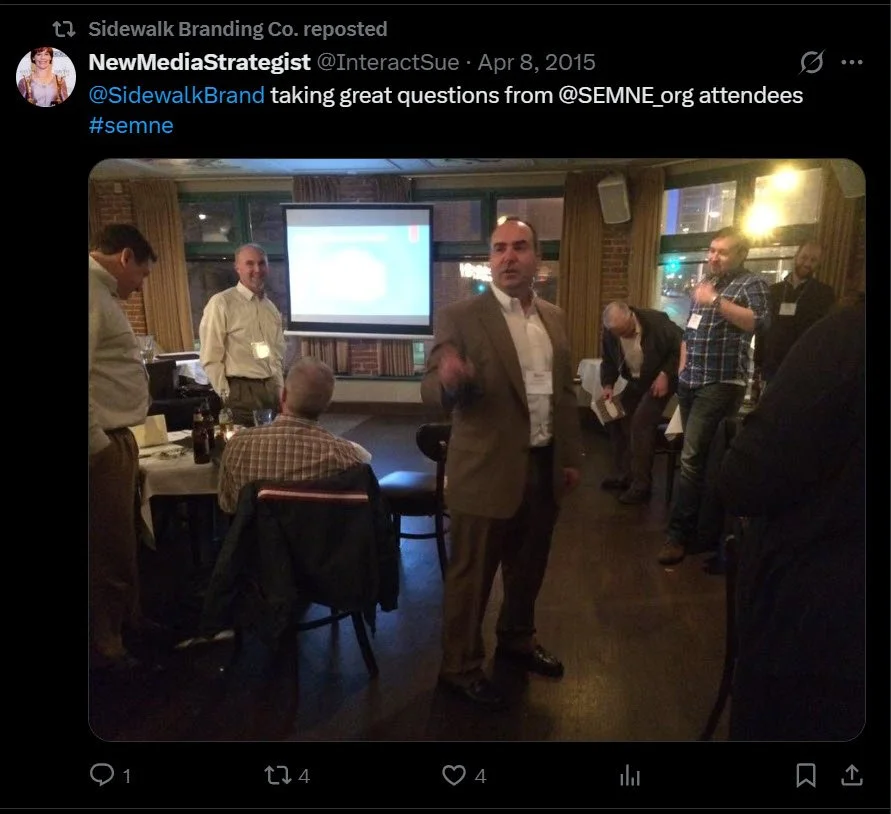
Chris Sheehy presenting schema strategy to a room of New England industry colleagues and competitors back in 2015 - long before AI search was cool.
My decision to stay the course with this behind-the-scenes code comes from nearly three decades in search engine optimization. Having guided business owners through search shifts since 1997, I have watched visual perks come and go. But the way systems organize facts about your business has never changed.
I have been teaching and implementing structured data for a long time. Back in 2015, I peer-presented an entire evening workshop on schema to a room of industry colleagues and competitors at Search Engine Marketing New England (SEMNE). Schema was still brand new to most people back then, and I built an Excel spreadsheet tool so everyone present could easily generate and program the code for their clients.
I have also been integrating AI into my search strategies since 2018. This long-term innovation focus has earned Omni Search Labs both the Rhode Island Tech10 Award in 2025 and the 2026 Technology Excellence Award in 2026. When I tell a business owner to stick with a strategy, it is because I have seen how these patterns play out over decades - not because I read someone else’s experience about it.
Google did not stop reading FAQ code. They simply stopped displaying it as an interactive visual widget on their results page. Google's own documentation confirms that their automated systems still read this code behind the scenes to understand what services your business provides.
Removing this code turns off the translator. It trades your business's long-term online clarity for short-term visual habits.
Note: The reference to Sidewalk Branding Co. in the picture is my first SEO agency, which I owned from 2009 to 2022 before selling it. Interestingly, the company that would go on to acquire it seven years later is also in this picture.
Looking Ahead: How AI and "Search Everywhere" Find Your Business
My framework for every business is built on Search Everywhere Optimization (SEvO). That means we don't just optimize for a single Google page; we make sure your business is recognized as a legitimate, trusted brand across the entire internet.
In technical terms, we want your business to be a verified "entity"—a distinct, recognized business that a computer can identify without confusing you with anyone else.
Going forward into an AI-driven market, structured FAQ code serves three vital business systems:
Google’s Master Fact-Database (The Knowledge Graph): Think of this as the internet's master encyclopedia. Google builds this database using background code to connect your business name to your specific services, location, and owner.
Generative & AI Answer Engines: When a potential customer asks ChatGPT, Gemini, or Perplexity a question like "Who is the best commercial contractor near me?", the AI looks for clear, pre-digested FAQ content to build its answer. FAQ code gives AI models direct facts to cite and recommend.
Alternative Search Engines: Platforms like Bing (which powers a huge portion of desktop business searches) still use this data to enhance search results and feed their own AI tools.
How This Fits the EQUATE Writing Framework
At Omni Search Labs, every piece of content we produce follows our EQUATE framework: Experience, Quality, Uniqueness, Authoritativeness, Trustworthiness, and Expertise.
Here is how background FAQ code supports those goals for a business:
Experience: 29 years in business gives us the foresight to spot lasting infrastructure value where traditional marketers see a dead end.
Quality: Providing clean, machine-readable data means search engines never have to guess what your business actually does.
Uniqueness: Direct answers focused on your clients' exact problems set your business apart from competitors who rely on generic marketing copy.
Authoritativeness: Explicitly labeling your questions and answers tells computers that you are the primary source of truth in your industry.
Trustworthiness: AI tools are far more likely to recommend a business that provides clear, verifiable facts.
Expertise: Clear FAQ formatting makes your industry knowledge simple for prospective clients to read and easy for search algorithms to process.
Questions to Ask Your Current Marketing Provider
The fallout from Google's May 7 update is a great test for your current marketing team or SEO provider. I encourage you to have a firm, business-to-business conversation with them.
Ask them this exact question:
"Since Google removed the visual FAQ drop-down boxes on search results pages, do you plan to stop adding FAQ schema to our website?"
If their answer is "yes," you should be concerned.
Stopping this work creates identity confusion for search engines and AI tools. If machines aren't 100% sure what specific problems you solve, they stop recommending your business when customers use AI to search for services like yours.
Frequently Asked Questions About FAQ Schema
-
Not at all. Google simply stopped showing the visual drop-down boxes on search results pages. The underlying code format remains 100% valid, and Google officially confirmed that leaving it on your site causes no penalty or harm.
-
No. Deleting it strips away organized information that search engines and AI tools rely on to understand your business. Leave the code right where it is so search crawlers can continue to read it.
-
AI search tools don't read websites like humans do; they scan for structured facts. When you pair a clear human-readable FAQ section on your site with organized background code, you give AI models an easy, verified source to pull from when answering user questions.
Behind-the-Scenes Code for Web Designers
(If you or your web developer wants to copy the exact FAQ schema generated for the three questions above, here is the JSON-LD snippet for this post)
{
  "@context": "https://schema.org",
  "@type": "FAQPage",
  "@id": "https://omnisearchlabs.com/blog/google-says-faq-schema-is-dead-viva-la-schema",
  "identifier": {
    "@type": "PropertyValue",
    "propertyID": "ISO-19115-3:MetadataID",
    "value": "urn:iso:std:iso:19115:-3:ed-1:v1:en:AcVa$"
  },
  "mainEntity": [
    {
      "@type": "Question",
      "name": "Did Google ban or punish website owners for using FAQ code?",
      "acceptedAnswer": {
        "@type": "Answer",
        "text": "Not at all. Google simply stopped showing the visual drop-down boxes on search results pages. The underlying code format remains 100% valid, and Google officially confirmed that leaving it on your site causes no penalty or harm."
      }
    },
    {
      "@type": "Question",
      "name": "Should we delete the FAQ code currently on our website?",
      "acceptedAnswer": {
        "@type": "Answer",
        "text": "No. Deleting it strips away organized information that search engines and AI tools rely on to understand your business. Leave the code right where it is so search crawlers can continue to read it."
      }
    },
    {
      "@type": "Question",
      "name": "How does FAQ code help us get recommended by AI tools like ChatGPT?",
      "acceptedAnswer": {
        "@type": "Answer",
        "text": "AI search tools don't read websites like humans do; they scan for structured facts. When you pair a clear human-readable FAQ section on your site with organized background code, you give AI models an easy, verified source to pull from when answering user questions."
      }
    }
  ]
}
