Before you trust a "best of" list, a review count, or an AI recommendation, check where the answer came from.
By Chris Sheehy

Earlier this year, after seeing their ad (below) I audited every single Rhode Island SEO company listed on the directory site Clutch, one of the largest B2B service directories on the web. There were 68 listings. It is a crowded market, and after 30 years in this field, I know many of them firsthand. When I noticed some discrepancies, I did the due diligence of checking every listing's website, address, and phone number by hand.
What I found honestly surprised even me. Nearly one-third of these listings were either out of business or had moved out of state. In a few cases, clicking a dead listing sent me to a spammy, potentially harmful website.
Let me put my own cards on the table right away. I run a website design and SEO studio in Rhode Island. We used to display badges from Clutch and its sister site, The Manifest, on our own website. After this audit, I took them down. This article is not a complaint about a directory ranking. It is a warning about what happens when outdated directory data gets treated as fact by business owners and by the AI tools advising them, often with total confidence.
How stale directories poison AI answers
Most of us have learned to question what we read in the news. It is so basic that we teach our kids to check what they read online.
Who published it?
Are they credible?
When was it published?
What do they gain if you believe it?
As business owners, we need to bring that same habit to business research. When you ask a search engine or an AI assistant like ChatGPT, Perplexity, or Google's AI Overviews to recommend a local website design agency, business consultant, or electrician, those tools do not drive past an office to see if the lights are still on. They scan the web for third-party lists they assume are accurate, credible, and reliable.
Large B2B directories sit right at the top of that pile. AI tools read these directory listings, treat them as market consensus, and repeat the results back to you in a smooth, confident voice. If the source list is stale, incomplete, or shaped by paid placements, the AI answer built on it will relay those exact flaws to you.
Unlike traditional Google or Bing search, where you review a handful of sites yourself until you find the most relevant answer, AI does the sorting using its own logic and criteria. It then delivers an agreeable, confident response. It is easy to assume AI applied real scrutiny to weed out outdated or closed businesses, but that is simply not how it works.
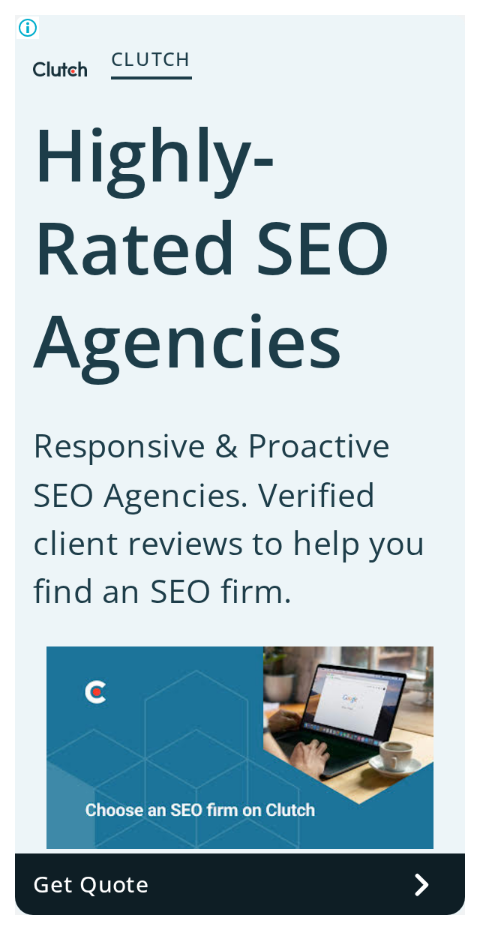
Clutch Ad on Google Ads
What a hand-checked audit in Rhode Island revealed
Rhode Island is a small enough state to verify one business at a time. That makes it a useful test case for how national directories actually hold up.
When I opened the Clutch directory for Rhode Island SEO companies, it showed 68 firms. I checked each one manually using three basic steps:
Visited every website URL. If the link broke, returned a 404 error (page not found), or redirected to an unrelated page, I searched for the company's Google Business Profile to confirm its status.
Checked every physical address. I verified whether the business still operated where the directory claimed it did.
Checked every phone number. I confirmed whether the listed number still belonged to that company at that location. If there was a discrepancy, I checked it against the Google Business Profile, and if it still did not match, I Googled the phone number.
The results were surprising: roughly 22 of the 68 listed firms were closed or no longer located in Rhode Island. I rechecked the list in November 2026, and the finding still holds.
This does not mean the remaining two-thirds are bad firms, nor does it mean they are the best. It proves something much simpler. A major directory presented as a map of a local market included nearly a third of companies you could not actually hire there. Any ranking, market count, or AI summary that treats 68 as the true picture starts off wrong.
How Clutch explained, in its own words, why the list stays stale
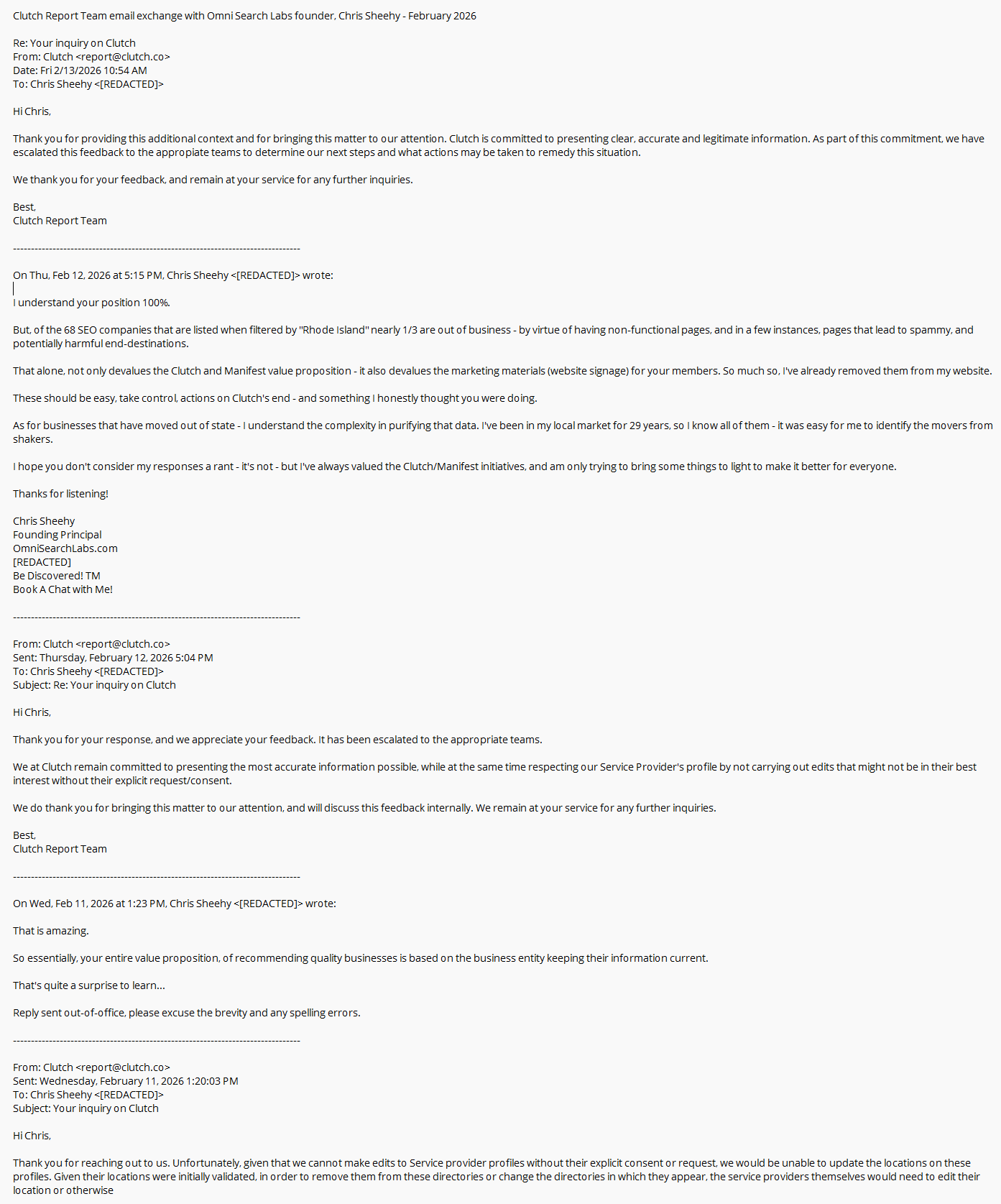
In February 2026, I wrote to Clutch to ask how closed and relocated listings could be cleaned up, even offering to do it for them since I had the data. Their replies matter because they explain the flaw in their own words.
"Unfortunately, given that we cannot make edits to Service provider profiles without their explicit consent or request, we would be unable to update the locations on these profiles. Given their locations were initially validated, in order to remove them from these directories or change the directories in which they appear, the service providers themselves would need to edit their location or otherwise request that we do so." Clutch Report Team to Chris Sheehy, February 11, 2026.
Think about what that policy means in practice. A company's location gets checked once, when the profile is created. After that, keeping the listing accurate depends on the business owner logging back in to update it. A company that has moved, might honestly not think to update these types of listings. And certainly one that shut its doors; is not going to log into a directory to ask for removal.
I replied the next day with the specifics of what I found:
"of the 68 SEO companies that are listed when filtered by 'Rhode Island' nearly 1/3 are out of business, by virtue of having non-functional pages, and in a few instances, pages that lead to spammy, and potentially harmful end-destinations." Chris Sheehy to Clutch, February 12, 2026
Clutch sent two follow-up responses that afternoon:
"We at Clutch remain committed to presenting the most accurate information possible, while at the same time respecting our Service Provider's profile by not carrying out edits that might not be in their best interest without their explicit request/consent." "Clutch is committed to presenting clear, accurate and legitimate information. As part of this commitment, we have escalated this feedback to the appropriate teams to determine our next steps and what actions may be taken to remedy this situation." Clutch Report Team, final reply, February 12, 2026
Clutch did not dispute the count. They escalated the message, offered no timeline, and committed to no fix. The full email exchange is attached as a supporting PDF at the bottom of this post so you can read every word yourself.
What this proves, and what it does not
Accuracy matters here. Overstating the problem would repeat the exact error I am warning against.
Here is what the record clearly shows:
Directory hygiene can fail by policy. Some major platform cannot (or will not) remove or update a dead listing without the listed company asking it to, even when the business no longer exists.
Page order is not purely merit. Clutch's own published methodology states that sponsored and featured listings (paid profiles) appear above organic (non-paid) results. Clutch also notes that sponsorship does not change a company's underlying Clutch Rank score, and that buyers can re-sort the page. Both facts belong together: payment shapes who you see first, even if it does not alter the internal score.
Directory reviews are usually invited, not spontaneous. Leaving a review on a B2B directory typically requires the reviewer to create an account or complete a verification interview. Because of that friction, firms normally invite hand-picked clients to review them there. A high rating built from vetted, invited reviews is useful context, but it is not a random sample of every client a firm has served. Many firms add a "Review Me On [Platform]" button to collect feedback, yet ask yourself how often you would create an account on an unfamiliar directory just to leave a review, instead of using more recognizable Google, OpenTable, or Yelp.
What this does not prove is that every directory is worthless, or that a specific company's reviews are fake. Clutch says it uses (to some extent) a human review-verification process, and a verified review can reflect a real client's honest experience.
The real issue for a buyer is simpler. A directory is a record of directory activity. It shows who built a profile, who put optimized it, who asked clients for reviews on that site, and who paid for top placement. It is not a merit-based audited census of a market.
I have worked in search since 1997, and I have seen this movie before. In the early days of the web, companies could buy hundreds of links pointing to their website in a single click, and for a while, those links worked to elevate a business in search engines. Eventually, search engines realized that any signal you can easily prompt, curate, or buy tells you more about who worked the system than who does the best work. Algorithm updates and penalties followed, and today most people recognize that tactic as spammy and risky.
Buyers, searchers, and the AI assistants they rely on need to recognize that same gap today.
It is not just Clutch: how profiles mislead buyers in every industry
If your only takeaway from this is "do not trust Clutch," you will miss the bigger picture. Almost every industry has directories and rating sites that measure platform participation and in-platform optimization (there are service companies for that), rather than real-world competence.
Home services and trades (Angi and Thumbtack): These platforms are built around paid advertising and lead bidding. The contractor sitting at the top of the page is often the one paying the most for leads, not the busiest or most skilled craftsman in town.
Legal services (Avvo): Attorneys cannot pay to raise their Avvo Rating, which makes the score look more objective at first glance. Yet Avvo's own documentation states that its algorithm grades the details filled out in a profile, such as listed experience, awards, speaking engagements, and peer endorsements, while client reviews do not affect the score at all. It rewards thorough profile management, not courtroom skill or case outcomes.
Manufacturing and remodeling (Thomasnet and Houzz): Both offer free basic listings alongside paid visibility upgrades and self-curated showcases. A job shop or design-build firm with the time or budget to polish its profile and invite reviews looks far stronger than a capable competitor running purely on referrals.
Dining (OpenTable): For an everyday example anyone can recognize, look at restaurant reservations. OpenTable is a paid network that charges restaurants monthly subscription fees plus per-diner cover fees on network bookings. Many standout independent restaurants skip it entirely and take direct bookings instead. If you or an AI assistant treat OpenTable's "top restaurants" list as the complete local dining scene, you miss every great kitchen that chose not to pay the toll.
None of this means these platforms have no value. It means a polished profile proves a business knows how to work a platform. It does not prove they do great work.
A quick note for business owners: If your own company shows up on a directory with outdated information, it is often not your fault. Many platforms automatically generate unverified listings from public records, or leave behind profiles created years ago by former staff or past agency work. Most owners never know those listings exist until a backlink audit uncovers them. Because AI tools read those forgotten profiles too, keeping your own footprint clean matters just as much as vetting the firms you hire.
Trust, But Verify: a 5-minute source check
President Ronald Reagan (#40) famously said, "trust, but verify." He did not mean distrust everything. He meant check what can be checked, even when it comes from a familiar source. In an era of fake news, paid endorsements, and cyber threats, verifying the source is already second nature in our personal lives. It should be in business too.
You do not need to become a researcher to protect your business from bad recommendations. Before you hire a firm based on an online ranking, a "best of" list, or an AI answer, run through this quick check:
Click the source, do not stop at the summary. Open the actual page the AI answer or search snippet cited. If you cannot trace the claim back to a clear source, treat it as unverified.
Scan for promotion. A page with banner ads, pop-ups, and sponsored callouts is selling attention first. That does not automatically make the information wrong or untrustworthy, but it should change how much weight you give the rankings.
Check for pay-to-play options. Look at the top menu and footer for links like "Advertise," "Get Listed," or "For Businesses." Directories rarely explain their business model right next to the rankings, so check the edges of the page.
Watch for "Featured" and "Sponsored" labels. Treat any featured or sponsored listing as an advertisement first and a recommendation second.
Verify the business outside the directory. Go straight to the company's own website. Look up its Google Business Profile. Confirm that the address, phone number, and active services actually match.
Choose primary proof over platform scores. Named clients, dated case studies with real numbers, and a real person you can speak with directly carry far more weight than a star rating on a site the firm had to join and promote.
If a source fails the first four checks, you do not have to throw the list away. Just downgrade it. Treat the names on it as raw leads, then run checks five and six on the two or three firms that make your short list.
A ranking is a lead, not a verdict
Directories can be a helpful starting point. They are never a finish line. Neither is an AI answer that summarizes them, no matter how polished it sounds.
Trust modern tools enough to save time. Verify enough that a closed business cannot get recommended to you, a paid placement cannot disguise itself as merit, and a curated review count cannot stand in for a real track record.
About the author: Chris Sheehy is the Founding Principal of Omni Search Labs, a Rhode Island search visibility firm, and a Subject Matter Expert for SCORE Rhode Island. He has worked in search since building his first business website in 1997. After raising the Rhode Island listings issue with Clutch in February 2026, he removed Clutch and sister organization The Manifest, as well as other non-merit-based badges from the Omni Search Labs website. This post is published so business owners can examine the source material for themselves.
Sources and supporting documentation
Email exchange with Clutch Report Team (February 11 to 12, 2026): Quoted above. Full exchange imaged below as a supporting file with this post.
Clutch Research Methodology: https://clutch.co/methodology and Clutch Rankings and Research Factors. States that sponsored and featured listings appear above organic results, and outlines how sponsorship interacts with Clutch Rank.
Avvo Rating Support Documentation: The Avvo Rating: What Lawyers Should Know and Client Reviews and the Avvo Rating. Explains that Avvo Ratings cannot be bought, are calculated from profile details and public records, and are unaffected by client reviews.
OpenTable Plans and Marketing Fees: OpenTable for Restaurants Plans Overview and OpenTable Boost Campaigns. Outlines published subscription tiers and per-cover network marketing fees.