
Why artificial intelligence names your competitor as the "best" or "most qualified" manufacturer, and how to fix your digital evidence ecosystem.
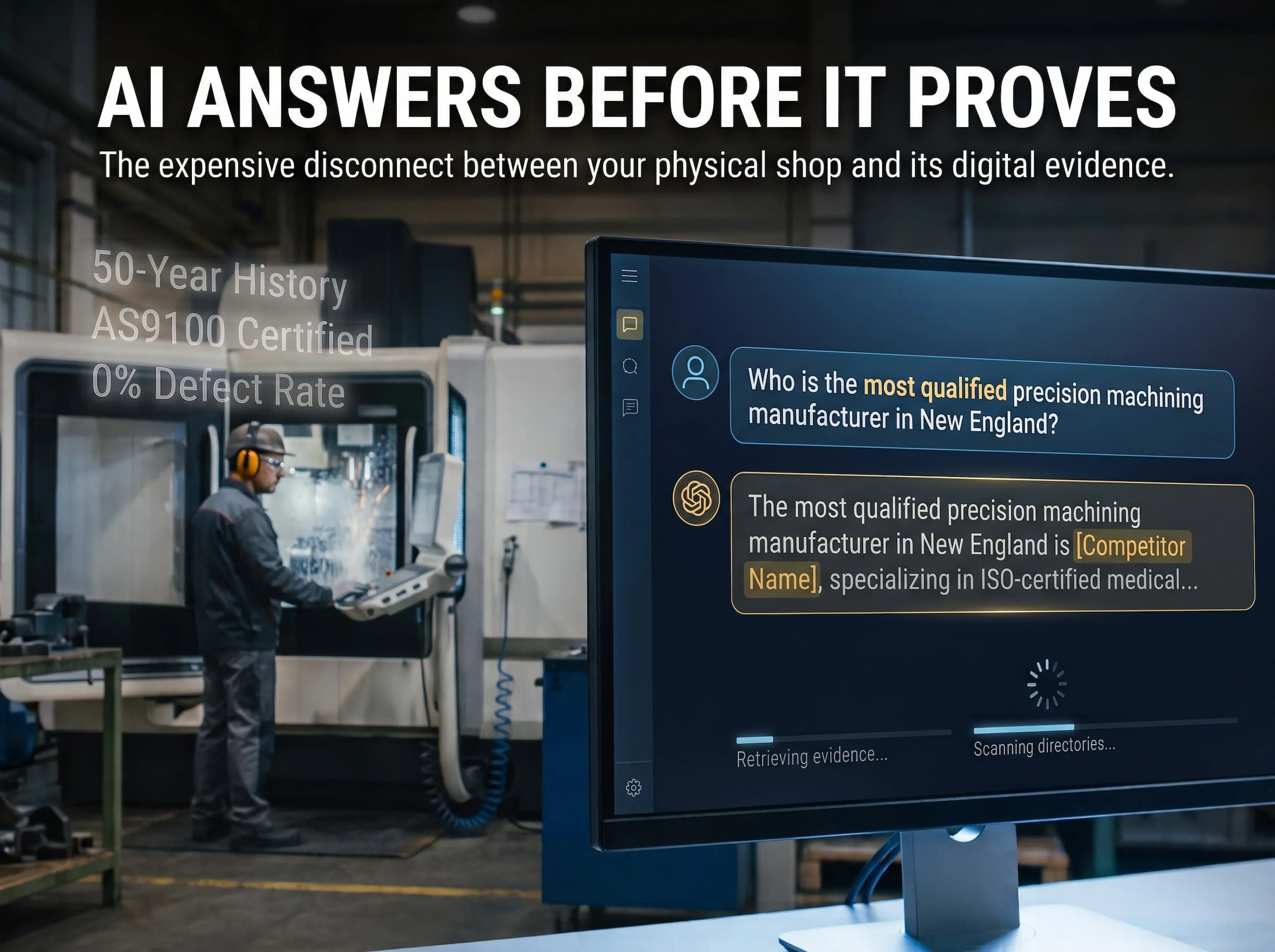
Picture a procurement director sitting at her desk looking for a precision machining partner to handle a new medical device component run. She does not open Google to scroll through ten blue links and four sponsored ads anymore. Instead, she opens an AI prompt and asks a straightforward question: "Who is the most qualified precision machining manufacturer for medical devices in New England?" Within three seconds, the model spits out a polished, confident answer naming two specific facilities, listing their machining tolerances, and highlighting their ISO certifications.
There is an expensive problem hidden inside that clean response. The shop the AI just crowned as "the most qualified" is rarely the best facility in the region. In reality, their equipment is a generation behind, their lead times run double what they quote, and their quality control cannot touch yours. Your floor runs five-axis CNC machines holding tight tolerances across aerospace alloys, your quality binders show fifty years of flawless delivery records, and your toolmakers have forgotten more about precision manufacturing than the competitor's floor manager knows. Yet the AI handed the recommendation to them and completely bypassed you.
That did not happen because the algorithm evaluated both operations and found yours lacking. It happened because, by its very nature, an AI search engine answers a question long before it can prove the answer. The default setting across consumer AI tools is speed. People want instant answers, so the machine produces them. If you want an AI to run a rigorous, investigative search, you have to know how to prompt it with deep constraints. In machine shop terms, you have to write the exact G-Code for the model. Without those coordinates, the system takes the easiest path available, and in doing so, it crowns whoever left the cleanest digital paper trail.
To compete for inbound queries, RFPs, and high-value purchase orders in this new search environment, manufacturers must grasp one foundational truth: artificial intelligence does not measure real-world performance. It measures discoverable digital evidence.
The Evidentiary Gap: Answering Before Proving
We need to understand how different this dynamic is from the search world we have lived with for the past thirty years. Traditional search engines behave like an old-school reference library. You type a keyword into Google, and Google drops ten index cards on your table. It is entirely up to the human buyer to click those links, browse the sites, read the about pages, and judge whether a company is legitimate.
AI engines do not behave like librarians. They act like assertive executive assistants who consider saying "I do not know" an unforgivable failure. When a buyer asks an AI to name the "oldest," "largest," "top," or "most qualified" manufacturing partner, the machine will not say that it lacks the real-time sensor data to tell. It cannot dispatch an auditor to walk your floor. It cannot run a micrometer over your finished parts, check your tool wear, or flip through the physical inspection reports filed in your quality manager's office.
The machine cannot see any of that physical excellence on its own. For those shop-floor realities to register with an algorithm, they have to be deliberately translated into digital evidence. That translation has to happen in two distinct places. First, it has to live on the front end of your website, which is the plain text, tables, and photography that human prospects read. Second, it must be programmed into the back end, which is the structured code and schema markup that traditional crawlers and AI bots ingest to confirm what is written on the front end. When those two layers fail to speak to each other, the algorithm treats your operational strengths as if they do not exist.
Take a look at how this disconnect plays out in real life. On one side, you have the day-to-day truth of your manufacturing floor. On the other, you have the narrow data points an AI retrieval engine uses to decide who wins the recommendation:
| Evaluation Factor | Your Shop Floor Reality | The AI Retrieval Engine |
|---|---|---|
| Track Record |
Offline Asset 50-year operating history, regional word-of-mouth reputation, and veteran toolmakers on staff. |
Corroborated Signal Nterprisers & ThomasNet profiles, state incorporation filings, and synchronized commercial directory listings. |
| Machine Capabilities |
Offline Asset 5-axis CNC equipment holding mil-spec tolerances across high-temp aerospace alloys. |
Corroborated Signal Detailed equipment tables marked up with Schema.org technical specifications on your domain. |
| Quality Assurance |
Offline Asset AS9100 quality binders on the desk, CMM inspection records, and a documented zero-defect rate. |
Corroborated Signal Verifiable certification numbers matched identically across registrar databases and associations. |
| Commercial Result | Invisible to the Model: The engine cannot confirm physical operational excellence. | Selected as "The Best": The system rewards the business presenting complete digital proof. |
Instead of touring your facility, the model conducts high-speed pattern matching across its training weights, web-indexed records, and entity databases. It looks for corroborating data. It cross-references citations, directory entries, technical capability lists, and structured entity data.
If your facility maintains unmatched operational capability but leaves a disjointed or outdated digital footprint, the AI cannot corroborate your status. As far as the algorithm is concerned, unverified capability does not exist. The AI awards the recommendation to the competitor that built the cleanest trail of evidence, even if their shop floor is inferior to yours.
The Information Quality War, Hallucinations, and Consensus by Default
Once you understand that an AI cannot inspect your physical shop, the next logical question is obvious: where is this machine getting its facts in the first place?
The short answer is that when AI models do not have solid facts, they invent them. We call that hallucination. When an algorithm runs into an information vacuum, its underlying probability math does not stop; it simply strings together words that sound statistically plausible based on general industry writing. That is how shops end up with nonexistent capabilities or incorrect specs attached to their names.
When the engine is not hallucinating, it scours an external web ecosystem to gather corroborating evidence. It pulls data from commercial trade registries like ThomasNet, Dun & Bradstreet, Nterprisers, and MacRAE'S. It queries public incorporation filings inside state databases like the Secretary of State corporate registry. It checks member listings within regional manufacturing councils and extension partnerships like RIMA and Polaris MEP in Rhode Island, or CAM and MassMEP in Massachusetts. Finally, it parses Google Business Profiles and the underlying code of your own website.
This reliance on broad web consensus creates a subtle, damaging trap that we call consensus by default. By design, generative AI models calculate the statistical middle of the road. When they synthesize information, they average out the details. In doing so, they strip away the very differentiators, unique tolerances, and custom setups that make your facility exceptional. If you make the mistake of using raw generative AI to write your website copy, you make this problem ten times worse. You feed the machine generic language, and the machine turns around and describes you as an interchangeable commodity.
Meanwhile, many executives have dismissed business directories as relics of early 2000s web marketing. In one sense, they are right. Classic web citations lost their ability to push a website up Google's organic rankings years ago. But AI search engines are treating those old directories like it is 1999 all over again. They treat structured directories as authoritative reference points to confirm whether a business is active, verified, and established.
Over thirty or forty years in business, things change. You acquire a competitor, relocate to a larger industrial park, open a secondary warehouse, retire obsolete product lines, and invest in multi-axis machinery that opens entirely new market opportunities. If nobody audits your digital footprint along the way, the web becomes a minefield of contradictions. One directory lists a facility address you left twelve years ago. Another shows a disconnected phone number. A third still claims you specialize in stamping services you discontinued before the pandemic, while saying nothing about the medical-grade machining you are actively trying to sell.
When an AI model runs across those discrepancies, it encounters friction. It cannot tell which version of your company is real. At the exact same time, automated web aggregators scrape and clone outdated competitor information across dozens of secondary sites. When three different directories repeat the exact same outdated claim about your competitor, the AI engine views that repetition as independent verification. The machine confuses repetition with truth. It recommends the competitor simply because their digital footprint agreed with itself, even though their shop floor cannot touch your capabilities. You lose the contract not because your manufacturing fell short, but because your digital evidence collapsed under cross-examination.
How Leading AI Platforms Form Their Verdicts
The problem gets more complex when you realize that not all AI platforms gather evidence the same way. Every major engine relies on its own retrieval architecture, its own data partnerships, and its own commercial index. If your marketing agency tells you they are optimizing your presence for AI, but they only talk about Google, they are ignoring the search engines that actually power modern generative tools.
To understand why your facility gets omitted while an inferior shop gets highlighted, you have to look at the specific search backends each engine relies on:
| AI Platform | Retrieval Engine | Top Citations & Signals | Algorithmic Friction Points |
|---|---|---|---|
| Google Gemini | Google Search Index & Knowledge Graph | Google Business Profiles, authoritative industrial domains, and structured Schema.org data. | Friction Points: Broken entity relationships, conflicting Google Map locations, and missing technical schema. |
| Perplexity | Hybrid Index (PerplexityBot + Bing API) | Live index citations, industry trade journals, press releases, and top-ranking directory profiles. | Friction Points: Unindexed technical documentation, absent web citations, and lack of public case studies. |
| ChatGPT with Search | Bing Search Index & OAI-SearchBot | Bing commercial results, partner media feeds, and deep on-page technical capability content. | Friction Points: Thin web copy, generic capability lists, and poor Bing index visibility. |
| Microsoft Copilot | Bing Index & Microsoft Graph | Bing Places, B2B supplier directories, state incorporation registries, and LinkedIn corporate pages. | Friction Points: Discrepancies across legal entity names, outdated directory filings, and unverified suite addresses. |
| Claude | Brave Search API & Pre-trained Weights | Brave independent web index, authoritative technical publications, white papers, and clear domain documentation. | Friction Points: Absence from independent search indices, contradictory machine parameters, and unsupported marketing claims. |
Look closely at the retrieval engines listed across that table. Notice how many times Microsoft Bing appears. Microsoft Copilot, ChatGPT with Search, and Perplexity all rely heavily on Bing's web index and commercial data infrastructure to ground their answers in real-time facts.
Then consider Claude, which has become one of the most widely used enterprise reasoning tools on the market. Claude does not use Google or Bing for live web retrieval; it connects to the Brave Search API, an independent web index with its own distinct crawling behavior and ranking criteria.
Every one of these search engines operates with different indexing requirements, different site verification portals, and different data priorities. If your digital strategy is built solely around ranking a website on Google, you are completely invisible to the retrieval pipelines feeding generative AI.
The Strategic Shift: The "Trust, But Verify" Buyer Journey
This brings us to a major myth circulating in modern marketing. You will hear self-proclaimed digital gurus claim that AI search has killed traditional websites, and that nobody clicks on web pages anymore. For consumer impulse buys, that might have a shred of truth. For high-stakes B2B manufacturing and commercial contracting, it is dead wrong.
Think about how a serious procurement manager, VP of engineering, or corporate buyer actually behaves. They might use Perplexity or ChatGPT for the initial discovery phase because it saves them hours of preliminary research. But no serious buyer awards a six-figure tooling contract or sends an aerospace RFP purely on the say-so of a chatbot.
The buyer journey follows the classic principle President Ronald Reagan popularized decades ago: trust, but verify.
Once the AI surfaces two or three candidate facilities, the buyer switches back to traditional search, in our research it’s usually Google, to cross-check the company name, read reviews, inspect executive leadership, and verify community standing. From there, the buyer clicks directly onto your website. That website is where the deal is ultimately won or lost. It is your digital manufacturing floor and strongest sales team. If your site confirms the exact technical tolerances, certifications, and project case studies that the buyer needs to see, you get the RFP. If the site is vague, outdated, reads like generic AI-generated fluff, and sounds like everyone else the buyer bounces and contacts the next shop on the list.
This complete journey is why we focus on the Search Everywhere Optimization (SEvO) idiom. SEvO is not about trying to trick an algorithm with keyword tricks. It is the disciplined practice of engineering, synchronizing, and corroborating your business identity across every touchpoint: your primary website, your back-end code, your B2B directory profiles, your state filings, and your regional association memberships. Everywhere. When every digital touchpoint tells the same verified story, the AI can prove your claims, traditional search confirms your authority, and your website closes the contract.
Building Verifiable Authority: The EQUATE Model
To make SEvO work for an industrial or commercial enterprise, you need a structured operational framework. At Omni Search Labs, we evaluate and build evidence ecosystems using our EQUATE content writing model:
Expertise: Replace generic sales promises with engineering facts. Do not simply say that you provide precision CNC machining. Document your specific machine models, your envelope capacities, your achievable tolerances, the exact alloys you cut daily, and your secondary finishing options. The more granular and technical your documentation is, the easier it is for an AI engine to extract and verify.
Quality: Provide undeniable proof of your quality standards. Display your active registrations, such as ISO 9001:2015, AS9100D, ISO 13485, and ITAR compliance. Make sure your registrar name, certification numbers, and valid date ranges match word-for-word across your website, your directory profiles, and official regulatory registries.
Uniqueness: Clearly articulate the specific capabilities that separate your shop from everyone else in the territory. If you run the only temperature-controlled five-axis cell in your county, have waterjet or laser cutting, in-house engineers for prototyping, or if you hold proprietary fixturing patents for complex thin-wall parts, put that fact in plain text. Give the algorithms unambiguous data points that prevent them from categorizing you as an average shop.
Authority: Build third-party corroboration into your digital footprint. Secure active directory listings and editorial mentions through established organizations like RIMA, Polaris MEP, MassMEP, and regional manufacturing consortiums. When respected external organizations cite your business, AI models treat those citations as high-confidence proof.
Trust: Clean up your legacy web presence. Audit your listings across ThomasNet, Dun & Bradstreet, Nterprisers, the Better Business Bureau, and your state Secretary of State corporate filing. Track down and eliminate old physical addresses, disconnected telephone lines, and conflicting legal entity names. Algorithmic confidence requires absolute consistency.
Experience: Back up your corporate history with detailed project case studies. Claiming forty years of excellence provides weak algorithmic proof on its own. Publish structured project summaries that detail the specific manufacturing challenge, the material specifications, the precision tooling deployed, the inspection protocol used, and the verified operational result. Create a /press page on your website to inventory where, other than your own website or blog, you have been published, quoted, mentioned, or featured.
Put Your Facility on the Verified Record
If your business depends on major commercial contracts and high-value purchase orders, you cannot afford to leave your digital reputation to algorithmic chance. You cannot let an AI model guess your capabilities, hallucinate your tolerances, or hand a qualified contract to an inferior competitor just because their citations were cleaner than yours.
It is time to see exactly what artificial intelligence engines and procurement buyers discover when they search for your capabilities. We will audit your directory consensus, inspect your back-end entity code, evaluate your search engine visibility across Google, Bing, and Brave, and close the evidence gaps that are costing your shop real revenue.
Schedule a Strategic SEvO Review with Chris Sheehy on Calendly
