
Recently, while serving as a subject matter expert through a local business development organization, I came across an all-too-common situation that highlights a major blind spot in modern business & marketing consulting.
The business owner had exceptional real-world credentials — elite industry certifications, advanced risk-assessment qualifications, and deep local trust, backed by recognized associations with regional universities and media outlets across Rhode Island and Southeastern Massachusetts.
To scale the business, the owner had engaged a local “Growth Strategist & Fractional Leader” and, at some point along the way, a complete website overhaul was executed. To be clear: we were not part of any conversations between the business owner, her advisors, or the web developer regarding scope, budget, or intent. We were brought in afterward, independently, to assess the finished result — and this post reflects only what the technical evidence shows, not any assumptions about who decided what along the way.
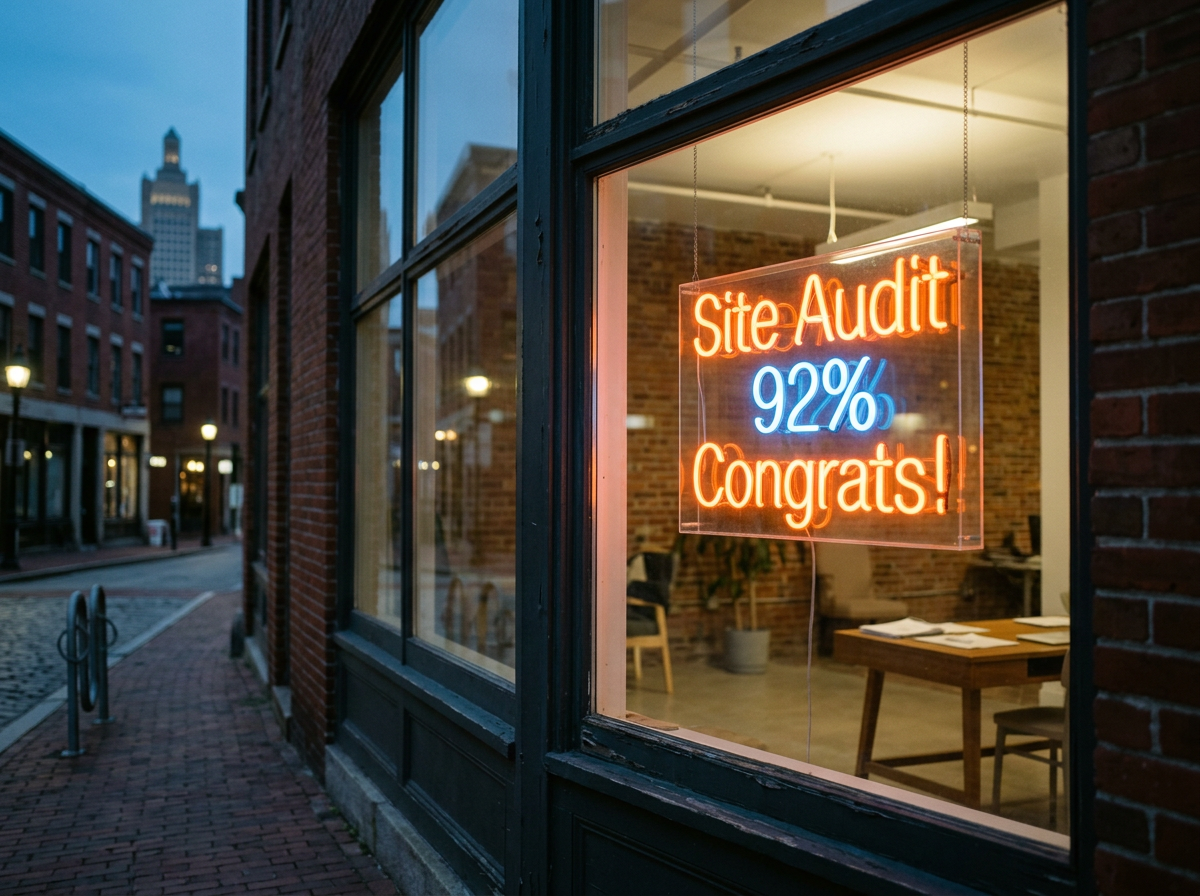
The new website looked sharp. Visuals were clean, modern, and professional. When run through a technical SEO audit tool, as is standard practice in my profession, the site earned a 92% SEO health score with zero critical errors.
By every visible signal, that looked like celebratory-worthy success. 🎉
Yet within days of launch, organic search traffic didn't just dip — it cratered (see graph far below). Two-year traffic data pulled from the leading website assessment tools show a sharp, sustained collapse in both organic (not paid for) and branded traffic beginning almost immediately after the new site went live, far steeper than the temporary dip you'd normally expect from a routine relaunch.
So, how does a website earn a 92% technical SEO score and become invisible across search and AI engines?
The Advisory Blind Spot
This gap exists because business strategy, visual design, and search (noun & verb) architecture are three different disciplines, and a website project can pass through all of them without anyone specifically owning search visibility.
Growth strategists specialize in operations, funnels, and organizational structure. Web designers specialize in aesthetics, layout, and branding. Neither discipline is trained in search engine mechanics, entity indexing, or answer engine optimization — and no single audit tool is built to catch that gap.
An automated site-health score works like a municipal safety inspection for a commercial building. The inspector confirms the wiring is safe, the plumbing works, and the fire exits are clear. That's a real and useful check — it tells you the building is safe to enter. It does not tell you whether the business inside has any customers walking through the door.
Automated audit tools measure baseline operational mechanics. They are not a replacement for a 30-year experienced search visibility specialist. And with that, here's what that audit tool, with a 92% passing score didn't catch - that I did.
1. Discarded URL Equity (Missing 301 Redirects)
Legacy pages that had accumulated years of trust and indexation history with search engines — pages like an "About Us," a core services page, and a news/updates page — had their addresses changed or removed during the rebuild with no 301 permanent redirects put in place.
A 301 redirect works like an official change-of-address form filed with the post office. When a business moves offices, it tells the carrier where to forward the mail. Skip that step, and mail gets returned to sender while visitors show up at an empty building. Here, visitors and search bots following old links hit dead-end error pages (called a 404 page), and years of built-up search equity vanished the moment the new site went live — not gradually, but essentially overnight, which lines up with the sharp traffic drop visible in the site's search analytics.
2. Missing Metadata and the Modern AI Search Shift
A full technical crawl of the new site's live pages confirmed the gap precisely: only two pages — the homepage and one internal page — carried a written meta description, and neither one named the business's actual geographic service area. The other fifteen pages, including core service and contact pages, had none at all. Several of the site's primary pages were also thin on body content (word count), several running under 400 words, which compounds the problem: with no crafted description and limited page text to draw from, search engines have very little material to build a useful, accurate snippet from.
A meta description is the short summary that shows up under your link in search results. Some development teams have stopped writing them, on the theory that Google frequently rewrites them from page text anyway. That's a mistake for two reasons. First, when a meta description is accurately written to match both searcher intent and actual page content, Google is measurably more likely to display it exactly as written rather than substitute its own snippet. Second, and more importantly for 2026: Bing handles metadata far more strictly, and Bing is the index behind AI assistants like Copilot and much of what feeds ChatGPT's web search. Leave your metadata blank, and you're not just risking a worse Google snippet — you're handicapping your visibility inside generative AI answers as well.
3. Inconsistent Headline Structure
Search engines read a page hierarchically, starting with the H1 tag — the code equivalent of a newspaper's front-page headline. The crawl showed that most of the site's actual content pages — Services, Consultation, FAQ, the bio page — do carry a defined H1. The pages missing one entirely were the auto-generated author/admin pages and the blog category archive pages: technically low-value pages, but ones that are still fully indexable, meaning search engines are spending crawl attention on structureless pages instead of all the content that contribute to the work of being visible when someone searches.
4. Generic Schema Markup
The site relied entirely on generic, default platform schema — WebPage, Organization, BreadcrumbList, and similar boilerplate types automatically generated by the CMS — with no customized LocalBusiness or ProfessionalService structured data anywhere on the site.
Schema markup is machine-readable code that functions like a notarized business license behind the scenes. Think of it like a bag of chips. Your website design is the colorful front of the bag that attracts a human customer. The schema markup is the "Nutrition Facts" panel on the back. It doesn't change what's inside the bag, but it clearly labels and organizes the contents so anyone inspecting it can understand exactly what they're looking at.
Without that label, a search engine can tell that a page exists and that words appear on it — but it has no reliable way to confirm whether this business is a LocalBusiness or a ProfessionalService, what its exact service area is, or which specific licenses and certifications back it up. It's left guessing at ingredients from an unlabeled bag. A human visitor can read all about a business's certifications and university associations directly in the page copy, but without that same information coded into structured data, search engines and AI models have no dependable way to extract and verify those facts for themselves — they can only take the front of the bag on faith.
5. Erased Domain Authority and Untapped Search Demand
This is the number that ties the whole story together. Using SEMrush's Authority Score — a 1–100 logarithmic measure of overall site trust and ranking power, comparable to the gap between a national outlet and a small regional one — the business's score had actually dropped, from 4 to 3, in the period surrounding the relaunch.
One clarification worth making here: Authority Score, like SEMrush’s Authority Score, Moz's Domain Authority or Ahrefs' Domain Rating, is a third-party marketing metric. It is not a ranking factor. No search engine and no AI platform consults it when deciding what to rank or cite — Google, Bing, and every AI answer engine use their own internal, undisclosed systems for that. What these tools actually measure is a modeled composite of backlink quality, quantity, and site trust signals, built to approximate how a search engine likely perceives a domain's authority. That distinction matters, but it doesn't make the metric meaningless. Used correctly, it's a useful diagnostic for spotting trend lines: is a site's overall trust and link profile strengthening or eroding over time, relative to where it should reasonably sit given the business's history and credibility. For a business with this level of real-world credibility and years of prior web presence, that number should reasonably be in the double digits by now, trending up rather than down.
The site currently ranks for only a small handful of narrow, credential-specific search terms — plus, oddly, some stray ranking impressions tied to an unrelated out-of-state business, a signal of content from the old site perhaps. Keyword research pulled for the business's core service category tells the more important part of the story: broader, plain-language search terms that actual prospective clients use in Rhode Island run into the hundreds of searches per month — several multiples higher than the narrow credential terms the site currently ranks for. None of that broader demand is being captured because the site's content and metadata never speak that language.
6. Leftover Staging Files and Site Hygiene
Development environments create placeholder templates as a normal part of the build process. On this site, a test post was left live and publicly indexable, sitting alongside the real resources page — a page that in itself is thinly populated at just over 150 words, but with 3 live, and duplicated blog posts. Public administrative account pages were also left open and indexable. All of this splits online equity between identical pages and clutters the search and AI engines with content that has zero value to them, or a searcher.
7. Unleveraged Institutional Authority
The business has genuine, documented associations with major regional universities and news outlets. Human readers can find these mentioned in the text. But nowhere in the site's underlying code were these high-authority associations structured in a way that search engines or AI systems could verify and weight as trust signals — the equivalent of having real credentials but no way for an automated evaluator to confirm them.
8. Missing Compliance Pages
The site has no visible Privacy Policy or Terms of Service, despite running contact and consultation forms that collect visitor information. Beyond the legal exposure, modern search and AI crawlers increasingly treat these baseline policy pages as a trust and legitimacy signal — their absence is one more small data point suggesting an unfinished build.
9. Broken User Pathways and Formatting
Small details compounded the larger issues: brand elements weren't fully consistent across pages, and phone numbers weren't formatted to the international E.164 standard (e.g., +1XXXXXXXXXX). Without that standard formatting, click-to-call buttons frequently fail on mobile browsers and office VoIP systems common in business offices — a quiet but real leak in lead capture.
The Value of a Second Set of Eyes
This is exactly the kind of gap a strong advisory network, like the ones in Rhode Island, is built to catch. The business development organization coordinating this review brought us in for an unbiased outside technical review.
There's no full resolution here yet, and there doesn't need to be one for this to matter. What matters is that a real, quantifiable risk to the business's future revenue was identified before more damage compounded — and that happened because the organization proactively looped in outside subject-matter expertise rather than assuming a clean visual relaunch and a passing audit score meant the job was done. That's the advisory process working as intended.
The Strategic Takeaway for Businesses
A visually appealing website that search engines cannot interpret is an expensive liability, and a 92% health score will not tell you that.
If you're working with fractional executives, general business consultants, or web designers on a site relaunch:
Ask their expertise in Search Engine Optimization (SEO) and AI Optimization (AIO) - the current term for this merged strategy being Search Everywhere Optimization (SEvO).
Require a comprehensive 301 redirect map for every historical URL before any new design goes live.
Craft custom meta descriptions for every page, explicitly stating primary geographic markets and core services for both Google and AI search engines.
Implement custom structured schema markup for your business entity, and to prove your professional credentials, licenses, and service boundaries directly to search algorithms.
Publish baseline compliance pages — Privacy Policy (and maybe Terms of Service) — especially if the site collects any visitor data.
Ensure phone numbers, headlines, and branding elements follow consistent and well documented technical standards.
Treat visual design, business strategy, and search architecture as distinct disciplines that must be coordinated, not assumed to overlap.
The business in this review has genuine real-world authority and deep expertise. The gap wasn't in the quality of the business — it was in a set of technical translation steps that no single role in the process was specifically responsible for catching.
True search visibility is never guaranteed by any audit health score. It's built by making real-world expertise undeniable to both human clients and search algorithms alike.
Wonder how your website would score? Just ask…
